
Protocols
A written protocol for every threat.
For every palm disease that kills, and for every new tree and palm, the response is written down before it is needed. What starts it, the steps in order, who signs, and what you get in hand. When a threat shows up on your property, nobody improvises.
At a glance
Eight protocols, one way of working.
A protocol is our response once a threat is suspected or confirmed, starting with sampling and lab testing. Every protocol follows the same rule: field condition first, then the recommendation. A photo is a reason to look. A lab result is a reason to act. Treatment, removal and diagnosis calls are made by an ISA Certified Arborist.
| Protocol | Threat | When it starts | First step | Lab confirmation | Plan layer |
|---|---|---|---|---|---|
| Lethal bronzing | Killer | A lab-confirmed positive on trunk tissue | Draw the zone. We recommend testing every susceptible palm in it | Required before the zone opens | Protect |
| Fusarium wilt (sterilized handsaws) | Killer | Pruning any of the seven host palms the client names | Handsaws only, cleaned and flamed between palms | Any one-sided frond death is sent to the lab | Protect |
| Ganoderma butt rot | Killer | A conk at the base, or decline on a property with a history | Inspect the lower trunk and root boss | A conk confirms it. Sawdust to the lab only with no conk | Protect |
| Palmetto weevil | Killer | A high-risk palm, or frass and odor at the crown | Crown check every visit on high-risk palms | Not needed. Found in the field | Protect |
| Pine bark beetles | Killer | Pitch tubes, boring dust or a fading pine | Read the tubes and lift a bark flap | Not needed. Confirmed on site | Protect |
| Storm response | Serious | A named storm, June 1 to November 30 | Clear the priority map, then an arborist-led walk | Only for a suspected disease afterward | Protect |
| Tree and palm establishment | Serious | Every new planting on a Health Program property | An initial assessment of each install, findings reported to the client | Only where a disease is suspected | Monitor |
| Establishment at scale | Serious | A new community putting in thousands of trees and palms | Measure the water each tree actually gets | Soil and water tests on a schedule | Monitor |
Plan layers follow our philosophy: Monitor (look, test, report), Manage (pruning, removals, staking) and Protect (respond to a confirmed threat).
Killer · Lethal bronzing
Lethal bronzing zone protocol
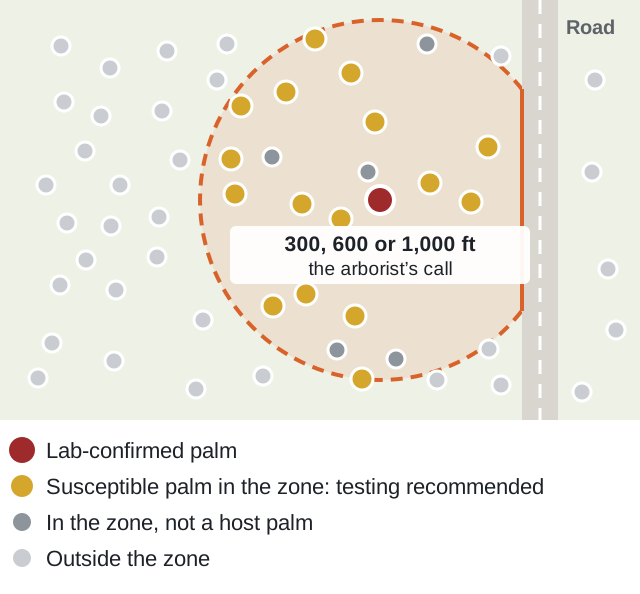
When it starts: Only a lab-confirmed positive on trunk-core tissue. A suspicious palm is a reason to test, not a trigger. An inconclusive first result is re-cored and does not open a zone on its own.
- Draw the zone. Our certified arborist picks one of three sizes around the infected palm: 300, 600 or 1,000 feet (about 90, 180 or 300 m). Susceptible palms reachable through untreated turf are added, and the edge snaps to a hard boundary. Treatment stays on the client’s property.
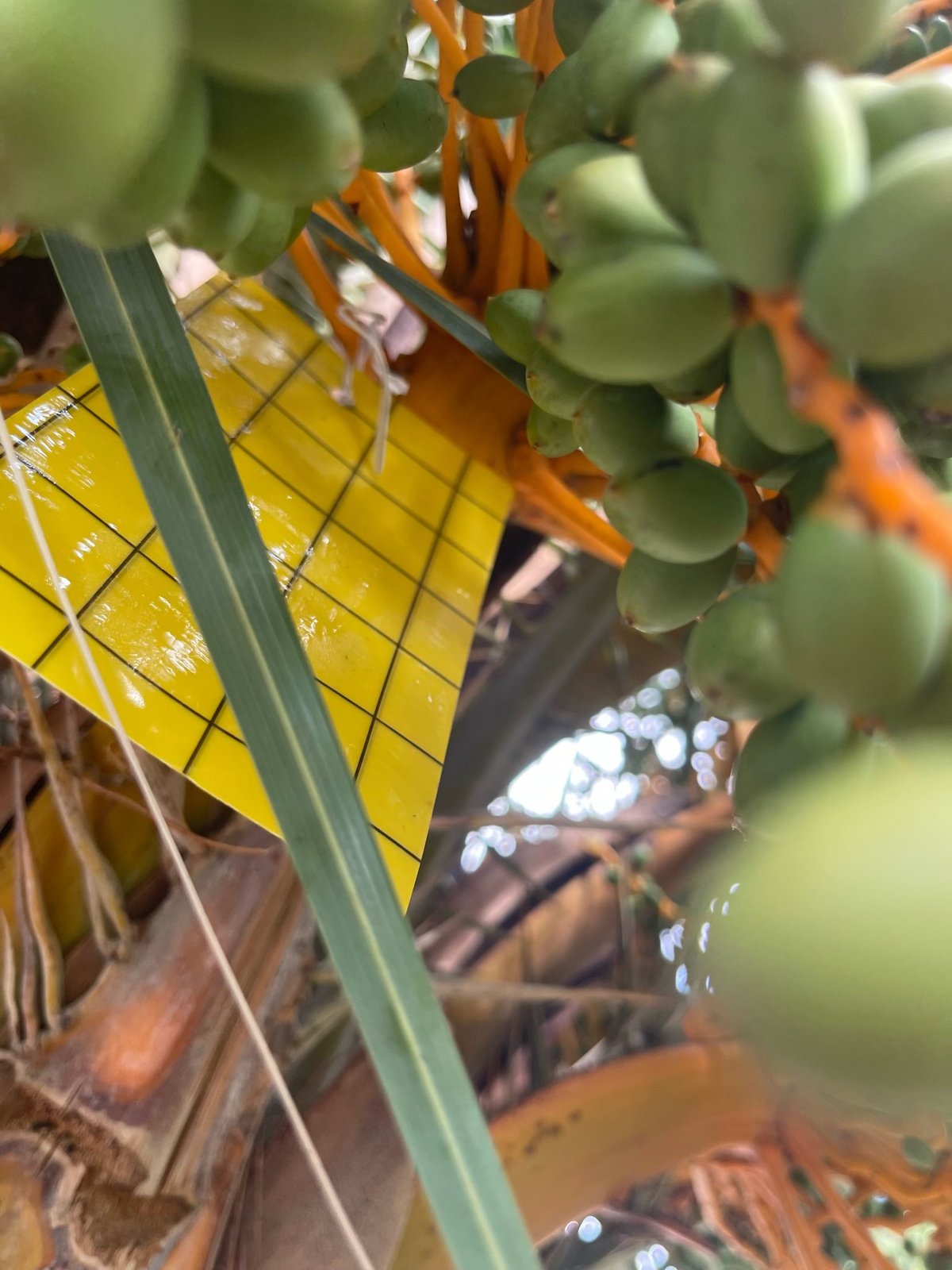
- Test the baseline. We recommend testing every susceptible palm in the zone, and our certified arborist makes the call for each property. A palm can come back Not Detected when the cored tissue does not carry the disease yet. In every zone we have tested, the sweep has found more infected palms, so in our opinion it is worth considering. Confirmed positives are removed, early green-canopy positives first, with the insect knocked down before removal.
- Suppress the insect. Turf and shrubs first, where the planthopper raises its young, then canopy knockdown by label. No blanket community drench.
- Re-monitor. Sticky traps and symptom tracking at every visit. A palm is cored again only on a trigger.
- Clear. Three trap sets after the spray, at about day 7, 30 and 55, each hung about 7 to 10 days. All three clean and the boundary stable, the zone clears. Then about 12 months of quarterly watch.
This is a protocol we are building to help clients as best we can. Nothing reverses lethal bronzing in an infected palm, and no protocol can promise an outcome. The goal is to hold the insect down, pull infected palms out fast and keep testing.
Killer · Fusarium wilt
Sterilized handsaws on host palms
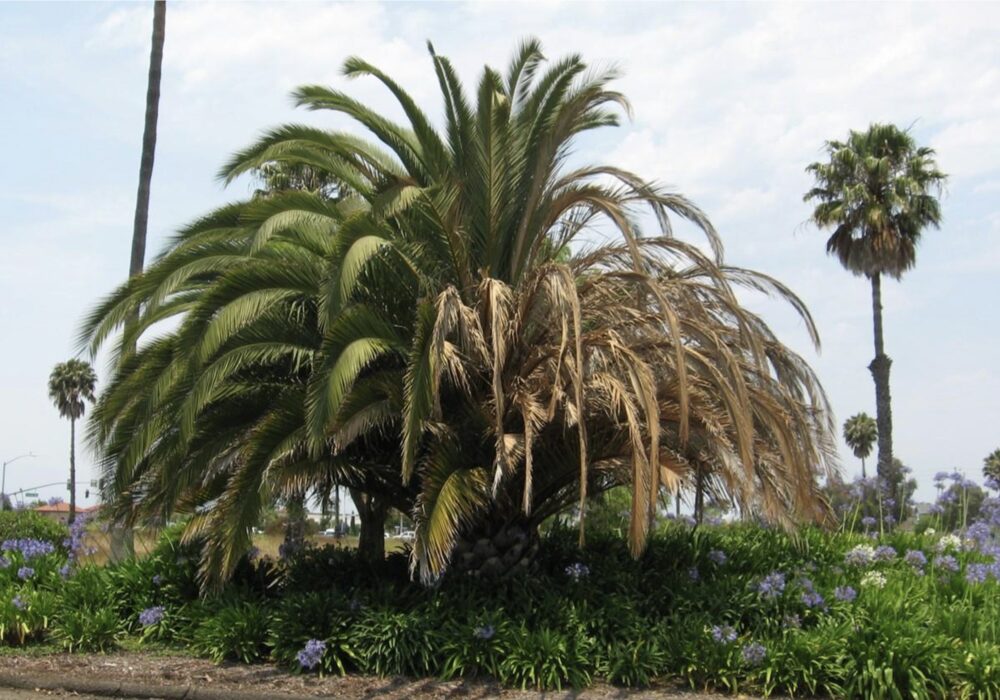
When it starts: Fusarium wilt moves from palm to palm on pruning saws. On the palms the client names, usually the date palms, every cut is made with a sterilized handsaw.
- Name the palms. Seven Fusarium hosts: Canary Island date, Medjool, Sylvester, Senegal date, queen, Washingtonia and Sabal (cabbage palm), the Sabal at a lower strength. Bismarck palms get the same hand-saw treatment against Thielaviopsis.
- Handsaws only. No chainsaws on named palms.
- Clean between every palm. Wire-brush the blade clean of sap and sawdust, spray it with disinfectant (25 percent household bleach or 50 percent isopropyl alcohol), a quick torch pass, then let it cool before the next cut.
- Cut only what our standard allows. Dead fronds and flower and fruit stalks. Nothing green above the 9-and-3 line.
- Stop and flag. One-sided frond browning, an oozing trunk lesion or a collapsed crown on a named palm: stop on that palm, switch to fresh saws, flag the office and recommend a lab test.
Killer · Ganoderma butt rot
Ganoderma protocol
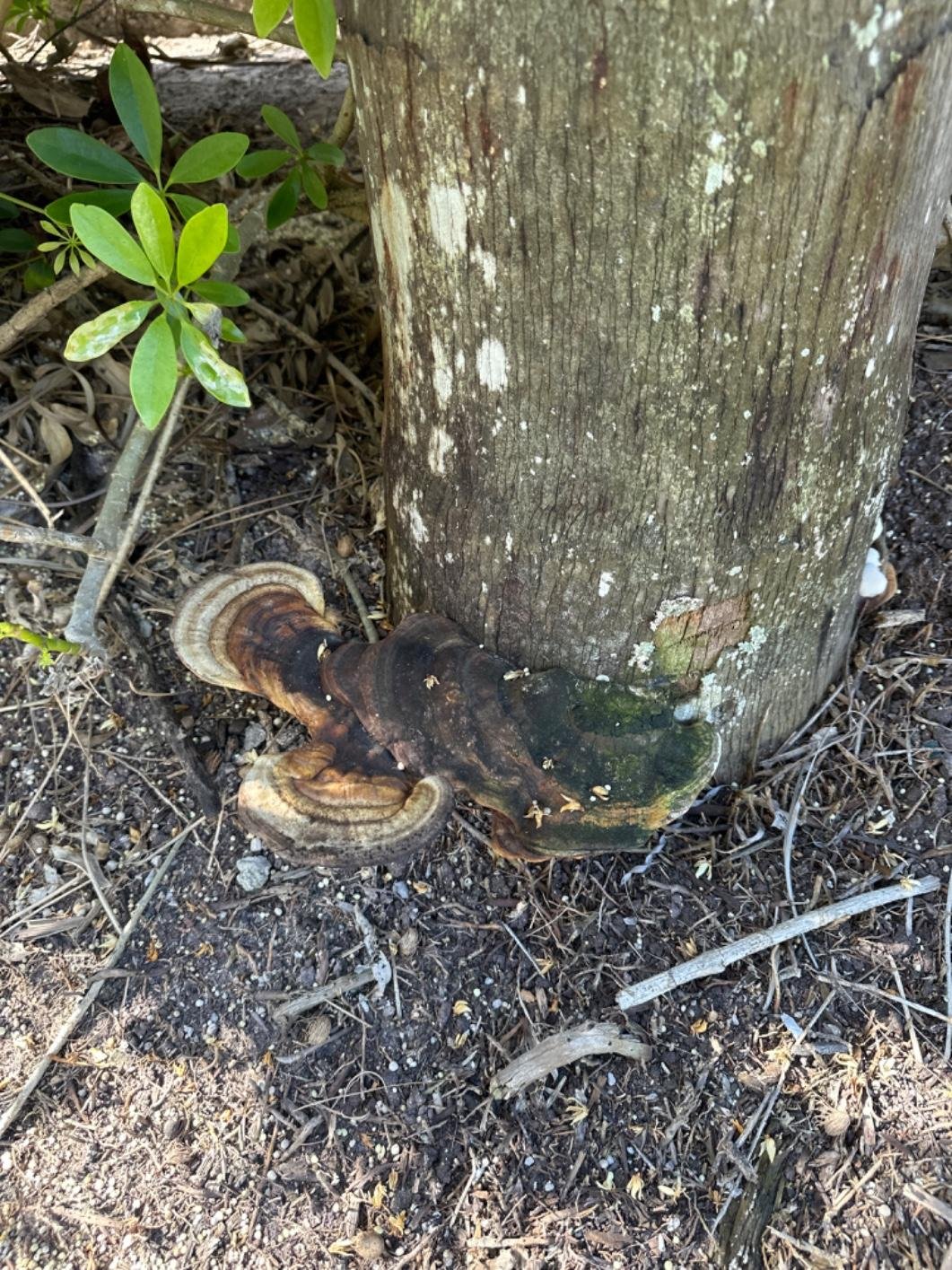
When it starts: A conk found or suspected at the base of any palm, a declining palm on a property with a Ganoderma history, or a high-value palm whose lab result would change the removal decision. All palm species are susceptible.
- Inspect the base. The root boss and lower trunk, between the old leaf bases on cabbage, Washingtonia and date palms. Once a property has a confirmed case, every visit includes a whole-palm inspection.
- Classify. A conk confirms it, with no sample needed. Decline with no conk is Suspected, and only then does a sawdust sample go to the lab. A conk, internal rot or a lab Positive is Confirmed: a terminal sign.
- Put it in writing. A confirmed palm gets a written removal recommendation on every report while it stands. Keeping it is the client’s call, and it stays on the watchlist.
- Remove it right. Stump and root ball out, or ground with every grinding hauled off. No infected chips as mulch, and no burying palm tissue.
- Replant with eyes open. Replanting the same spot is a risk decision made with the client, and the risk is written down.
Killer · Palmetto weevil
Palmetto weevil protocol
When it starts: A palm goes on the high-risk list when it was transplanted in the last 6 months, pruned in the last 60 days, is a Canary Island date, Bismarck or latan palm, or stands near a lightning strike or construction. Any field sign starts it too.
- Crown checks every visit on high-risk palms: frass and a fermenting odor at the crown, entry holes 8 to 12 mm (about 0.3 to 0.5 inch), the spear test, larvae, adults.
- No fresh wounds. No green-frond pruning, above all in flight season, roughly March through June or July. Every cut on a palm is permanent.
- Protect the high-value palms. A soil drench plus a crown spray on recent transplants and heavily pruned high-value palms, as our certified arborist’s case-by-case call. Targeted palms only. No blanket drenching.
- Assess the bud before writing a palm off. Severe damage is not the same as a dead bud. We have seen a badly damaged palm recover after a bud drench because its bud was still alive.
- Remove fast when the bud is gone. Egg to adult takes about 84 days, which is the window to get an infested palm out before the next generation flies. Chipped on site or hauled at once, never stockpiled.
Killer · Pine bark beetles
Pine bark beetle protocol
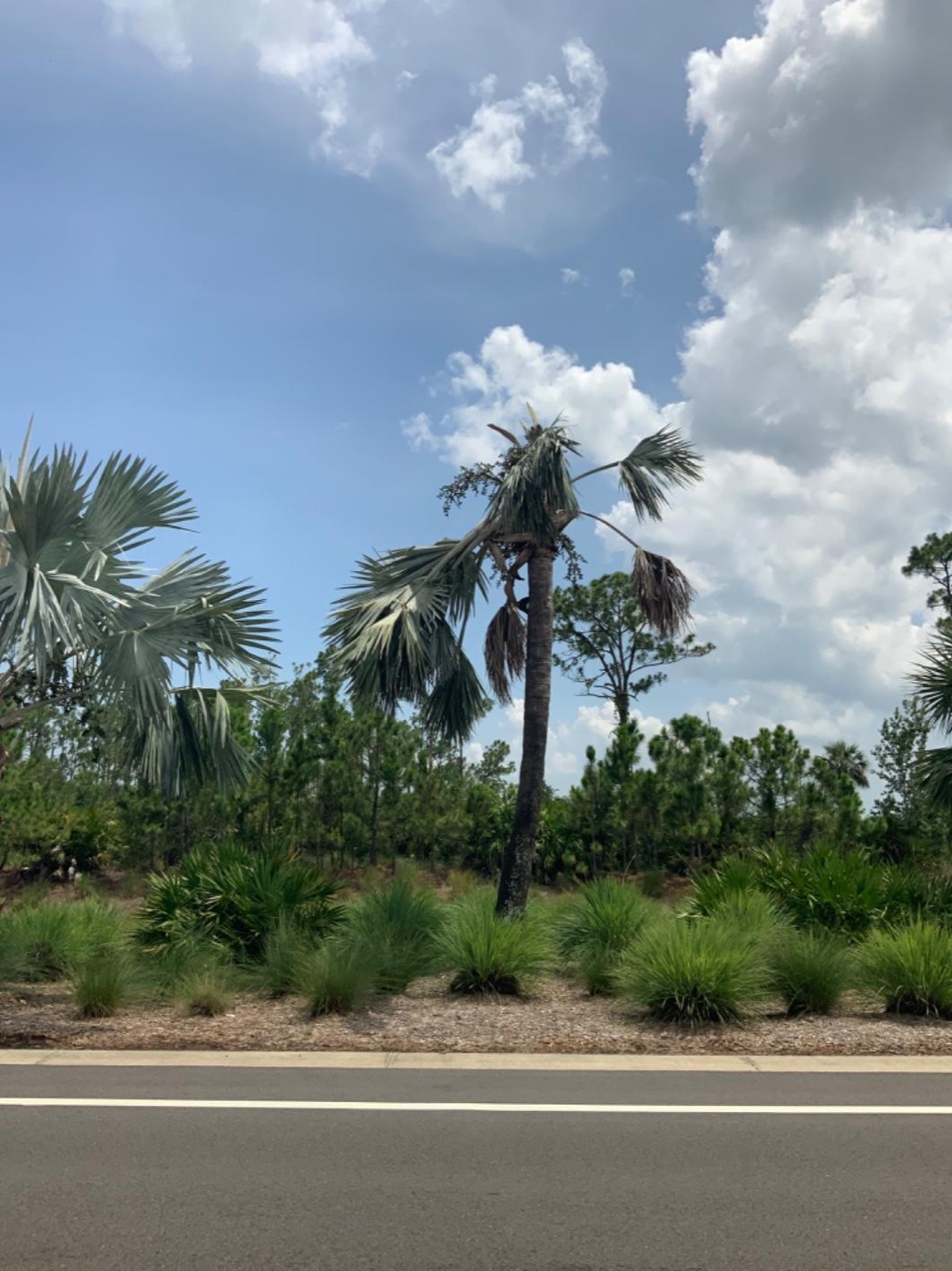
When it starts: Pitch tubes, boring dust or a fading crown on a pine, or a pine under stress: drought, root injury, flooding, soil fill over roots, lightning or storm damage. Also when anyone says southern pine beetle, which has never been recorded in South Florida.
- Name the beetle. Ips leave dime-sized tubes, 2 cm (about 0.8 inch) or smaller, scattered high on the trunk and branches. The black turpentine beetle leaves tubes up to 5 cm (about 2 inches) low on the trunk.
- Read the gallery. Lift a bark flap. Ips cut long, straight galleries with the grain from a small central chamber. The black turpentine beetle cuts a wide gallery with a fan-shaped patch of larvae.
- Apply the survival rule. Fewer pitch tubes than the trunk diameter in inches: the pine might survive, and protection may be worthwhile.
- Protect by grouping. High-value pines in the same grouping as an infested or stressed pine, within about 500 feet (150 m), get a bark spray to runoff, on our certified arborist’s call. Never every pine.
- Remove what is lost. An infested pine that could fall on people or property is removed and its debris cleared, because fresh slash breeds beetles.
Serious · Storm response
Storm response plan
When it starts: June 1 through November 30 each year, and any declared event outside that window. The signed plan authorizes emergency clearance if communication is lost.
- Before June 1. A priority map agreed with the client (entrances, main roads, emergency routes, public areas, then neighborhoods), staging and disposal sites on file, and a pre-season walk of mature oaks, recent transplants and known defects.
- Clearance, as soon as safe. Fallen trees and palms pushed off roads, entrances, walks and building access.
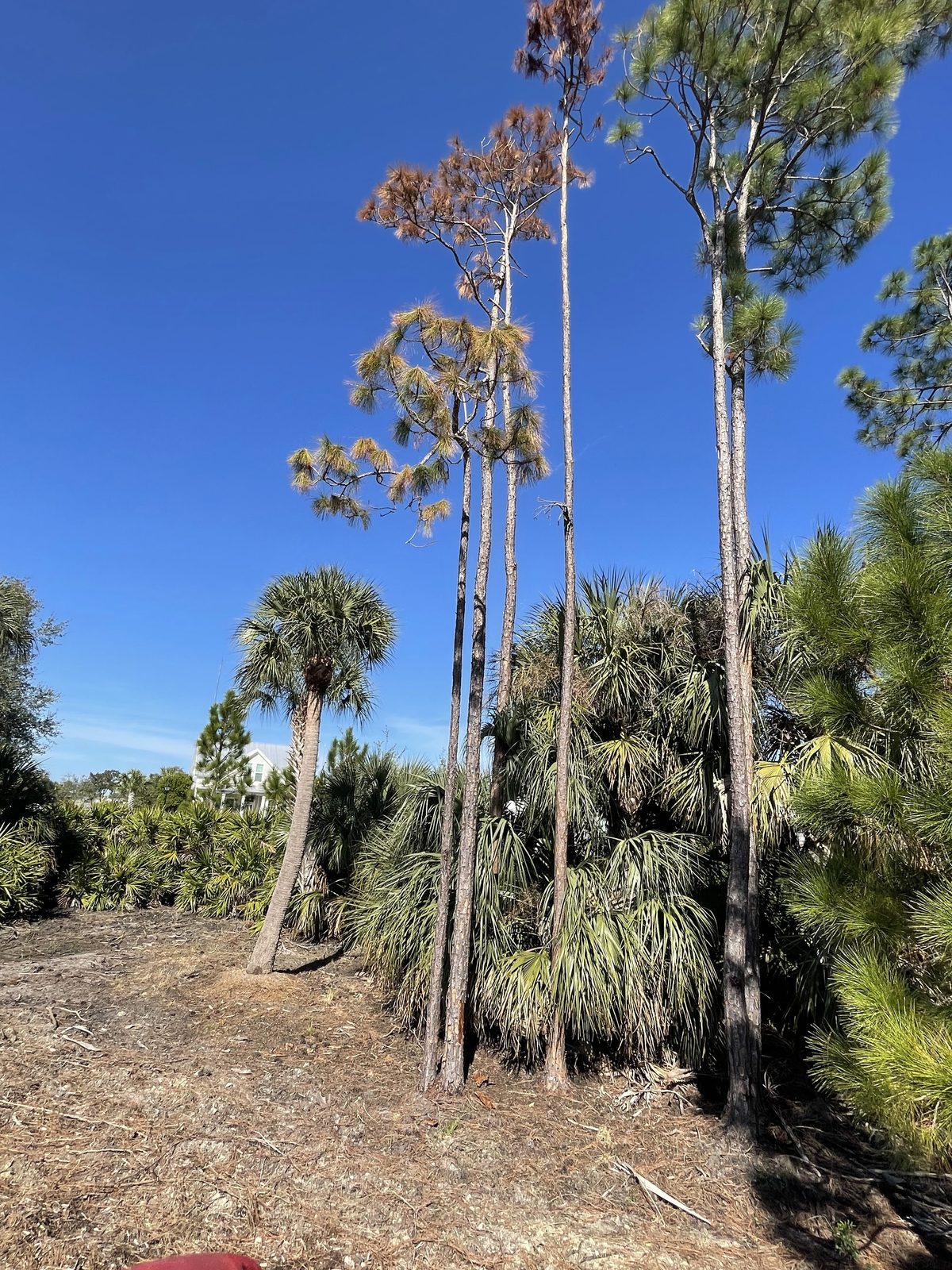
- Assessment, within 72 hours of clearance. An arborist-led walk. Every damaged palm and tree gets a work order by inventory ID, flag tape and a photo.
- Restanding, starting within 48 hours. Savable trees restood and staked before exposed roots dry, small trees first, aiming to finish within 7 days.
- Storm pruning and removals. Hazards first. Tree cuts to a branch collar, never stubs. Palms lose broken fronds only. Intact palms wait 6 months before any removal call.
- Recovery checks at 30, 90 and 180 days for stakes, salt and flood stress, decline, bark beetles and palmetto weevil.
Establishment · Tree and palm establishment
Trees and palms, from delivery to established
When it starts: Every new palm and tree put in by others on a Health Program property, at the level the plan sets. A new tree is the most expensive tree to lose twice: once to buy it, once to replace it.
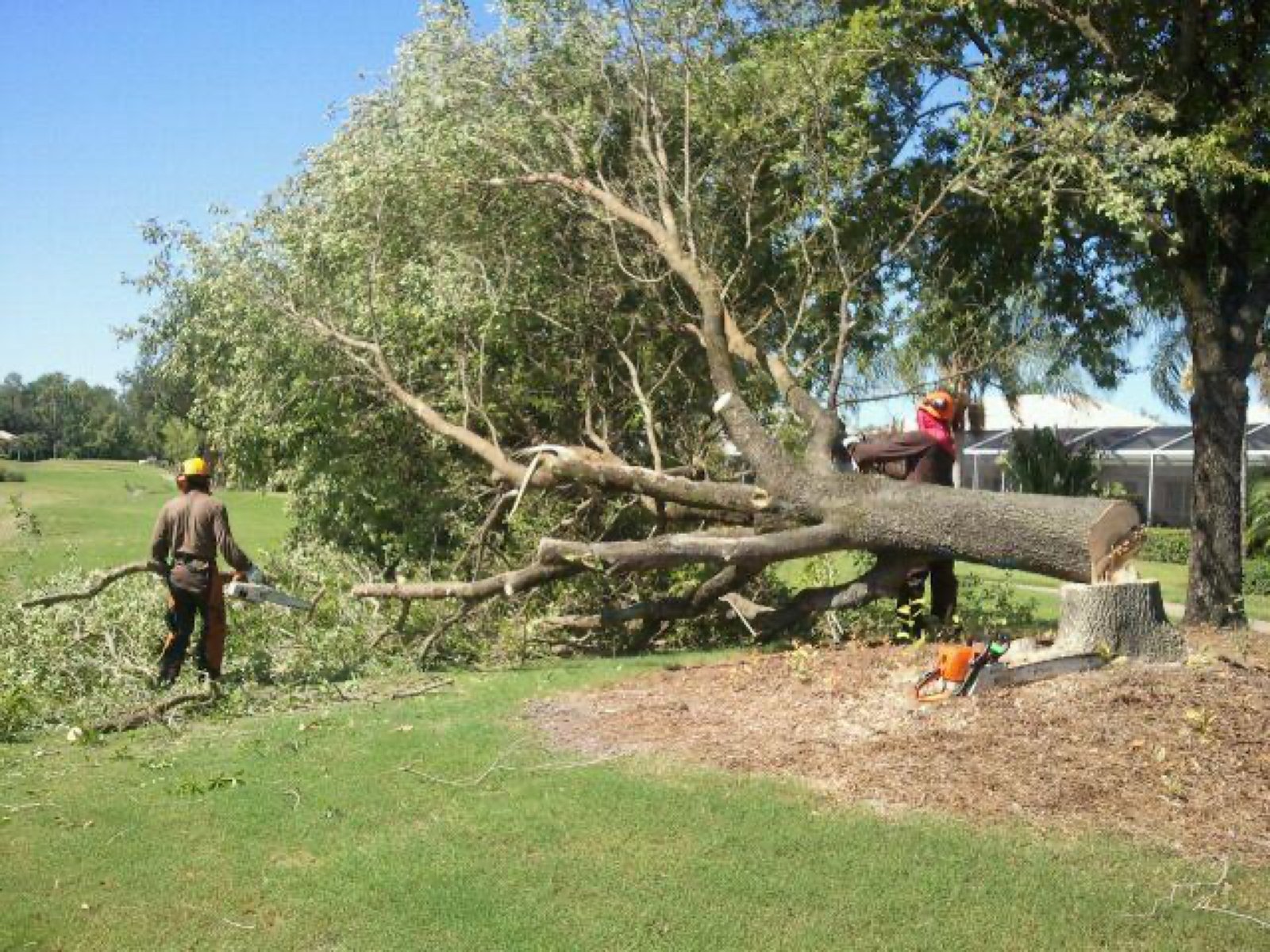
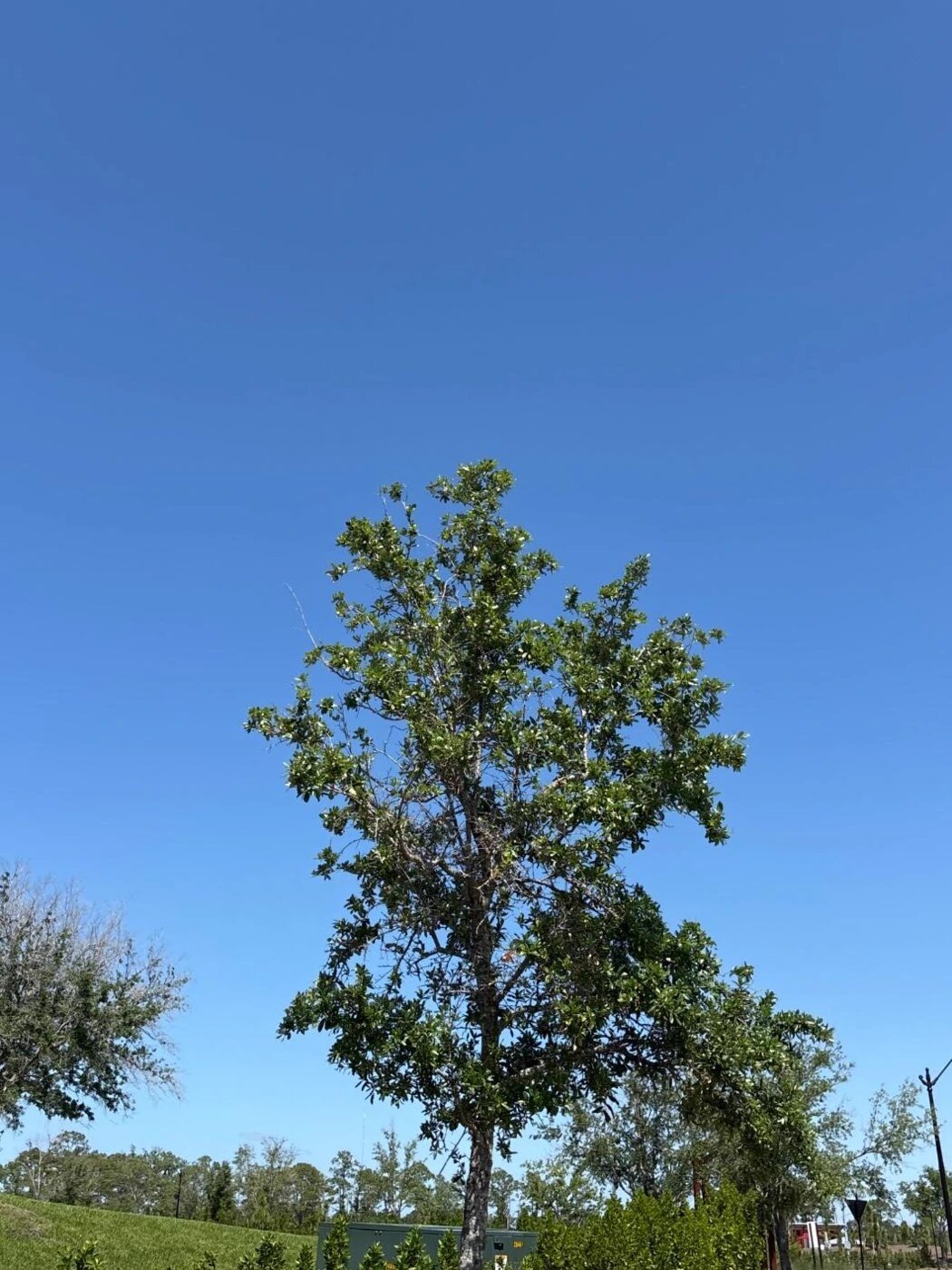
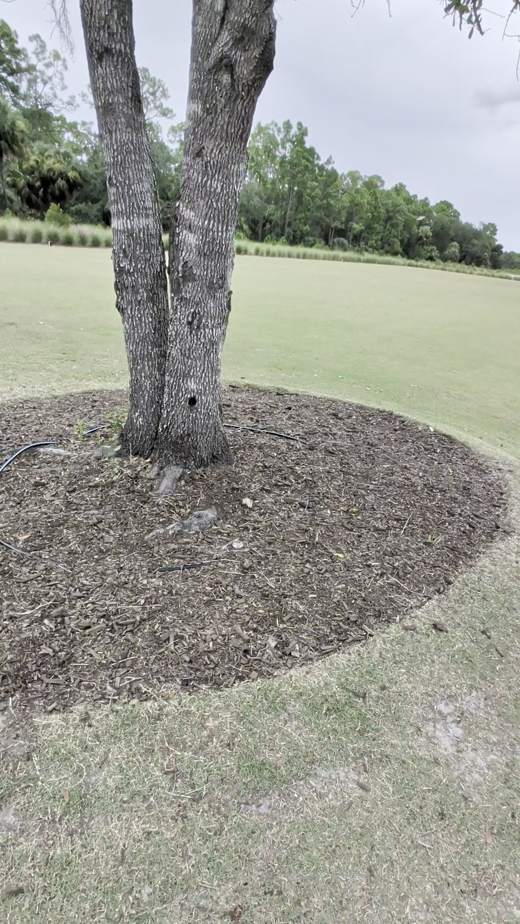
- An initial assessment, before or after the client accepts it. Every palm and tree, all the way around, photographed and tied to its ID: species and size against the approved plan, Florida Grades and Standards grade, root ball, planting depth, root flare, staking, irrigation reach and mulch. Our finding on each one, with anything that needs fixing, goes to the client in a report. The client and the installer settle acceptance. Best within 30 days of planting, inside the state’s regrading window.
- Track decline and loss. Each install is logged with the date we first assessed it. A dead or declining install goes to the client in writing the day we find it, with photos, cause and confidence, the first assessment date and the date found: “This tree died. It might be under your warranty.”
- Measure the water. Every visit: the water delivered, the rain at that planting, and the root ball moisture by hand, moist, never dry, never standing wet. Then the eight points: canopy, twigs and branches, trunk, root flare, mulch and berm, bracing, pests and disease, and photos from the same marked points. Palms are watered at the soil, never the crown.
- Flush and rescue. When the soil water shows salt, or in a drought, hydrant water goes on the root ball from our water trailer. Rescue watering goes on right away when the irrigation is not working, a flow meter reads zero, or a long dry spell runs. Level 3 starts sooner than Level 2. A certified arborist signs every watering, flush and treatment call.
- Stake it, then unstake it. Anchors outside the ball and a soft barrier on the trunk. Nothing nailed, cabled or chained into a palm. Tree stakes off by the end of the first growing season unless a county rule says longer.
- Carry each planting to established. Every new tree gets 2 years on the establishment schedule. Level 2 by trunk size: trees 8 in and up on the full visit schedule, trees under 8 in on 2 visits a year, both with fertilizer and MitoGrow. New palms of a Standard or Advanced species get the palm schedule for 1 year. A plan may instead put new palms straight onto their Health Program tier. Level 3: every new planting. About 3 to 4 months per inch of trunk caliper. Established means steady growth year to year, tip dieback stable or falling across two dry seasons, and roots crossing out of the ball.
Establishment at scale
The establishment program on a large new community
When it starts: We manage the palms and trees for a large independent special district that oversees a whole new town. Its inventory roughly doubled in three years, so most of it is young and still establishing.
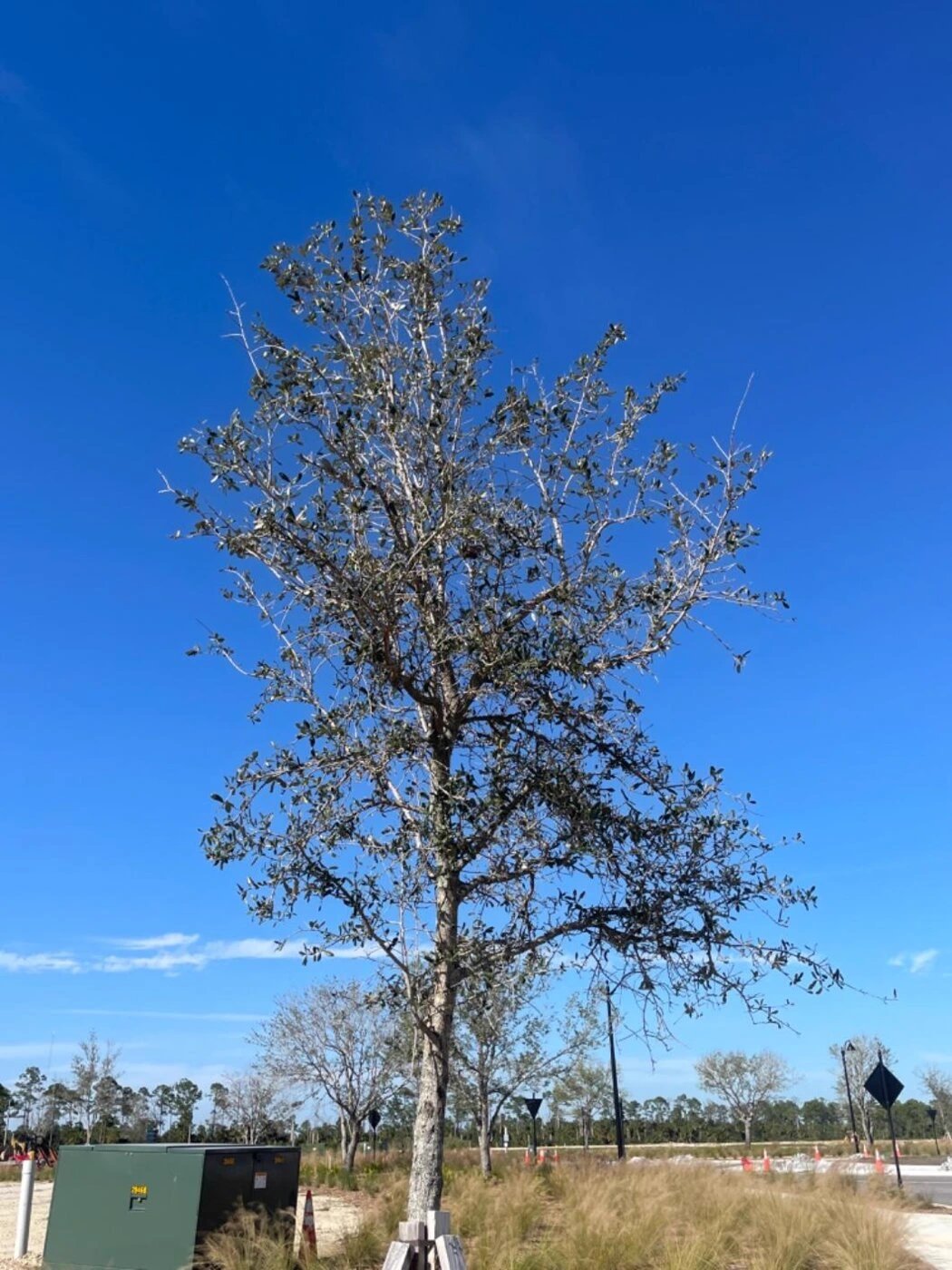
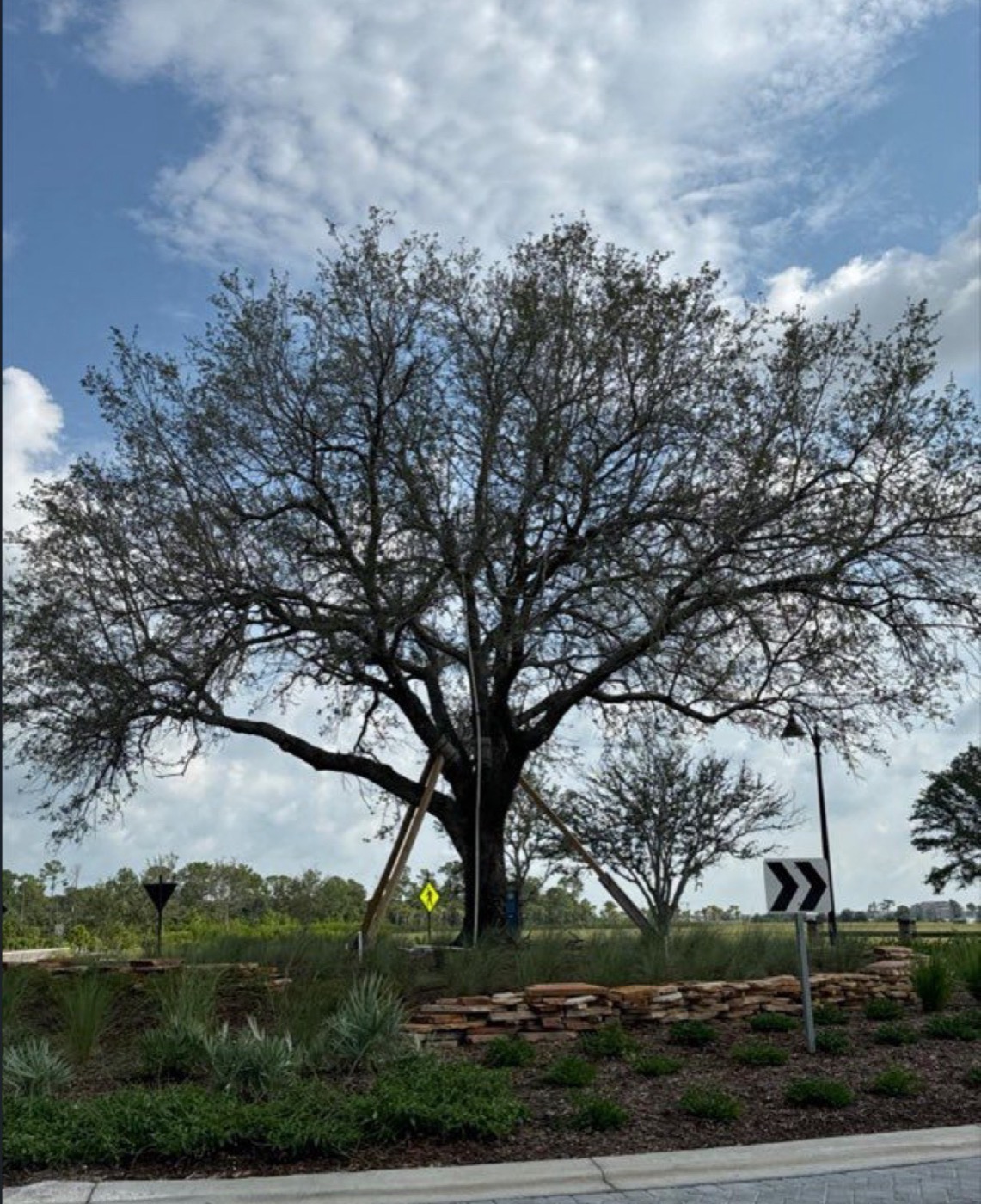
- Find out what is true. On one walk of 10 stressed oaks, all 10 were watered by just 2 bubblers, 6 had both bubblers on one side of the root ball, 6 had no tree ring or a berm too low to hold water, and on none was anyone measuring the water delivered. The water each oak got was assumed, not known.
- Measure the water. A flow meter on the bubblers, rain recorded for each oak, a rain gauge on site, and a moisture probe at the top of the ball, its edge and a foot into the backfill. Any gap is reported within 24 hours.
- Check the roots. Small holes at the edge of the ball on sentinel oaks, three times a year. White, firm tips crossing into the backfill mean roots are growing. Brown and brittle means dried out. Dark and soft means sitting too wet.
- Plan for drought. Watch, Drought 1 and Drought 2 levels step watering back up, with the client told within 24 hours of any change.
- Step down over three years. Weekly visits at first, then every two weeks, then monthly in the wet season, ending with a final establishment report for each oak.
- Assess and track every install. An arborist assesses every new install and reports the findings to the district, and every install is logged with the date it was first assessed.
“The intent here is not to place blame. It’s to provide these oaks with the water they need to survive.”A district landscape director, in an email to us
We do not water the trees and we do not install them. We do not inspect or manage the irrigation contractor, the installer or the site team. The program records what each tree gets and reports it, so they can act on facts. No program can promise a tree’s survival. These are the numbers we track.
FAQ
Questions boards ask about protocols
Why write a protocol before anything goes wrong?
Because the killers move faster than a board meeting. With the steps, the stop rules and the client options written down in advance, the first visit after a find is action, not a debate.
Do you treat a palm on sight?
No. A photo or a symptom is a reason to look closer. The lethal diseases are confirmed before any treatment or removal call: in a lab, or for Ganoderma by the conk. An ISA Certified Arborist makes that call.
Who decides whether a palm or tree comes out?
The client. We put the recommendation in writing, with the evidence, on every report while the palm or tree stands. Keeping it is the client’s call, and it stays on our watchlist.
Do protocols replace the Palm Health Program?
No. The program is the planned, recurring care that keeps palms vigorous. A protocol is the response when a threat is confirmed. Both live in one written plan, the 10-year Palm and Tree Master Plan.
What does a protocol cost inside a plan?
On a Master Plan at Protect what matters or the full program, these come at no extra cost: assessments, taking samples, the palmetto weevil protocol, the Ganoderma inspection and removal call, and ordinary pest treatment in scope. Priced on their own: lethal bronzing blanket treatments and sticky traps, pine bark beetles, and a new pest. Lab fees pass through at cost, with no markup.
Next step