Nutrition on calcareous soil
Availability before supply.
The limit is usually not how much fertilizer goes down. It is how much the palm can reach. On alkaline, limestone ground, a deficiency on a palm that is being fed is often a soil problem, not a supply problem. So we read the soil first.
Why palms cannot wait it out
A palm has no savings account.
An oak stores 15 to 30% of its dry weight as starch in its trunk, roots and branches. A palm stores less than 10%, mostly in the trunk. It lives on a steady supply of water and nutrients. Magnesium, potassium and manganese deficiencies show faster in a palm than in a tree, and by the time they show, the easy window has often closed.
Older palms feed new growth by pulling nutrients out of their lower fronds. Yellow lower fronds are often the palm eating itself.
- Three things defeat a feeding. High-pH bicarbonate soil, drought (nothing moves), and cool weather (slow uptake).
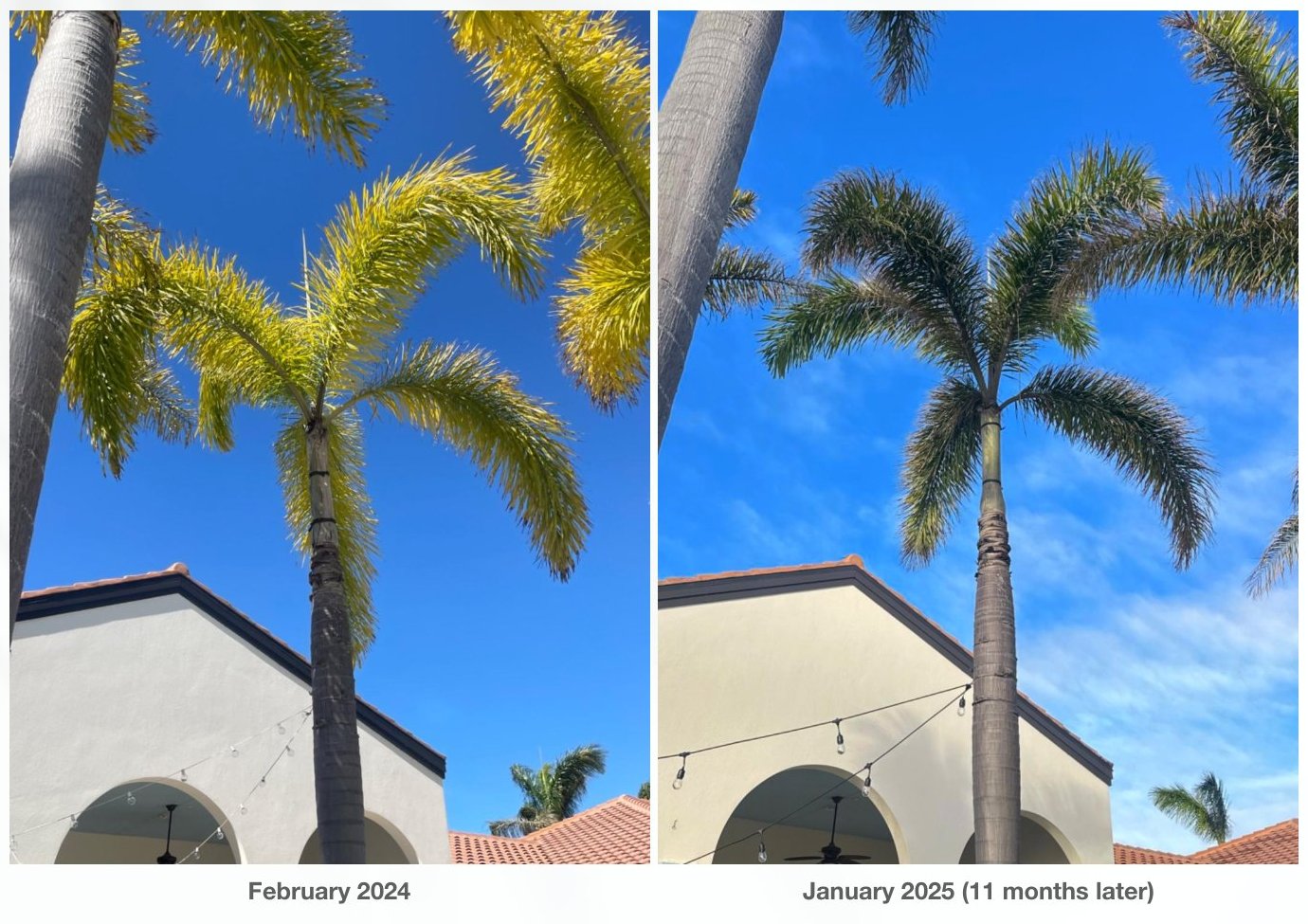
- The rain opens the window. Rain, near pH 5.6, briefly lowers root-zone pH, dissolves bicarbonate, flushes salt and frees locked micronutrients. That is when the palm feeds. In a dry season the window barely opens. The decline you see in February started in November.
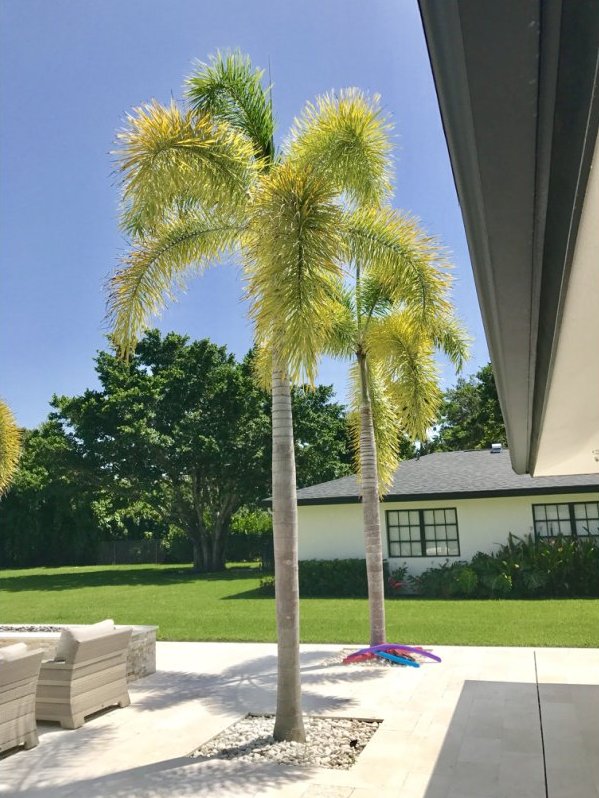
- Lawn fertilizer is not palm fertilizer. Turf products are heavy on nitrogen and can push a palm into potassium deficiency. Potassium is the most common deficiency in Florida palms.
- Steady beats heavy. Sandy soil can leach soluble nutrients in one hard rain. Slow-release, more often, does better than one big feeding.
Soil pH
We work within soil pH. We do not try to correct it.
Above about pH 7.5, iron, manganese and zinc become chemically unavailable even when they are in the soil. Boron locks up too. On calcareous palm sites we add no gypsum and no extra elemental sulfur. Here is why we do not chase pH with amendments.
- Sulfur cannot move it. Elemental sulfur cannot economically lower pH on calcareous soil. The limestone buffers it back.
- Gypsum is a sodium tool. It is pH neutral. We use it only where a soil and irrigation water test confirms a sodium problem.
- Calcium is already high. Our soils often run 600 to 1,100 ppm calcium and up. More calcium works against magnesium and potassium uptake.
- The fertilizer carries enough. The sulfur in a complete granular is the only acidifying the palm program needs.
- The water matters as much as the soil. Hard irrigation water keeps adding lime. That is why the water test sits next to the soil test.
Master-planned communities and HOAs
In a new community, the challenge is the soil.
New phases are built on fill and lime rock, and the nutrients are not there yet. In one community we tested the first phase, where the oaks have grown for years, against a newly built phase on the same property. The new ground read very low in four nutrients a palm needs.
| Soil test | First phase | New phase |
|---|---|---|
| Potassium | 257 | 16 |
| Phosphorus | 60 | 2 |
| Manganese | 7.9 | 0.2 |
| Zinc | 6.1 | 0.2 |
UF/IFAS Extension Soil Testing Lab, May 2024. mg/kg. The full test.
The ground gets better with time, slowly. We place every community in one of three phases, and feed for the phase it is in.
Adaption
Raw, compacted ground. Feeding works against the soil, so it is steady and often, with water to carry it.
Strengthening
The soil holds water and nutrients better. Feeding starts to stick, and the strugglers show clearly.
Maturity
The soil works. Steady feeding, little extra water, and pruning that leaves the palm its reserves.
How community age changes the ground
What we see. Across the tens of thousands of palms and trees we manage, in all three phases, palms on a steady program move up the health ratings over time, despite the ground they grow in. That is the goal. No program can promise it for every palm. How we rate palm health
Chapter takeawayThe limit is usually not how much fertilizer goes down. It is how much the palm can reach.