The ground
Built soil, not grown soil.
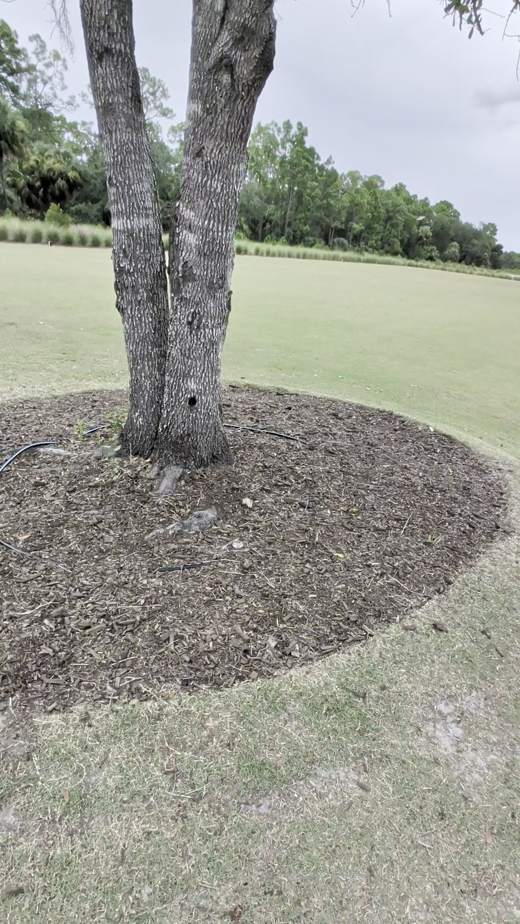
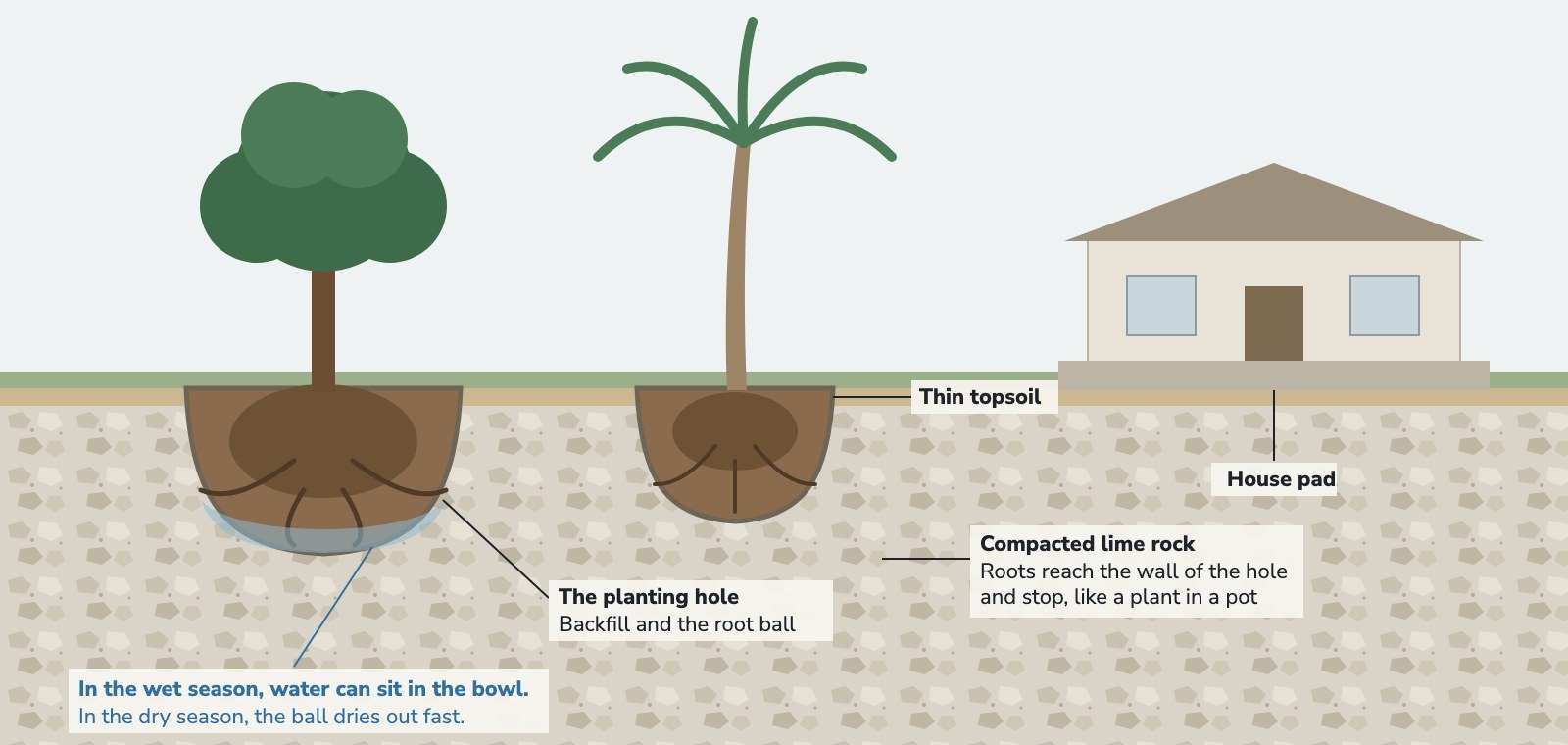
A forest builds its soil over centuries. A new community builds it in weeks. Native topsoil is scraped, 18 to 24 in (46 to 61 cm) of low-organic fill goes down, and the site is graded and driven on until it is as firm as a road bed. That is good for a house. It is hard on a root.
From nursery to new home
In the nursery, life is easy.
A field-grown palm or tree spends years being fed, watered and protected. Then it is dug, moved and planted in compacted fill, often on a corner where nothing else would grow. Once a palm sits in ground that does not meet its needs, nutrient decline usually shows within 1 to 3 years.
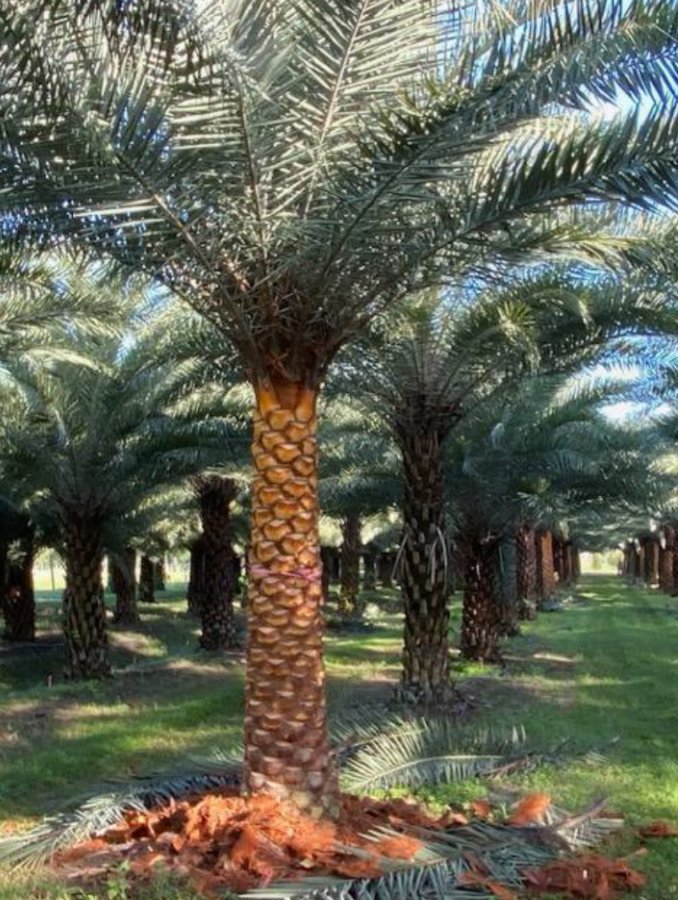
Everything on schedule
- Fed regularly.
- Irrigated regularly.
- Protected from stress.
- Room for roots in loose, worked soil.
Survival mode
- Compacted subsoil, often with a high pH.
- Feedings that are thin or missing.
- Irrigation that is irregular, or never measured.
- Pavers, underplanting and ground cover over the roots.
Bulk density
How tight the ground is packed.
Bulk density is the weight of dry soil in a given space. The higher it reads, the less room is left for air, water and roots. University of Florida research on Florida home sites found new construction cuts the pore space in sandy soil by about a third compared with forest. In sand, root growth stops near 1.7.
Grams per cubic centimeter. Source: UF/IFAS research on soil amendment for Florida development sites.
- 65 days. About how long Florida takes to go from a flat lot to a finished home. The soil gets no time to recover.
- Tilling alone does not hold. Sand that is only tilled settles right back. Organic matter is what keeps it open.
- Compost doubles usable water. In the UF/IFAS work, compost tilled into new-home sand roughly doubled the water plants could use.
- Decades, left alone. Compacted ground drifts back toward natural levels over about 30 years. With compost, aeration and good irrigation, it is more like 5 to 10.
- Around planted roots, we work smaller. Full rebuilding is not realistic near roots and utilities. The levers are mulch, top dressing over time, targeted air-spade work in the root zone, and water.
Compaction and the penetrometer
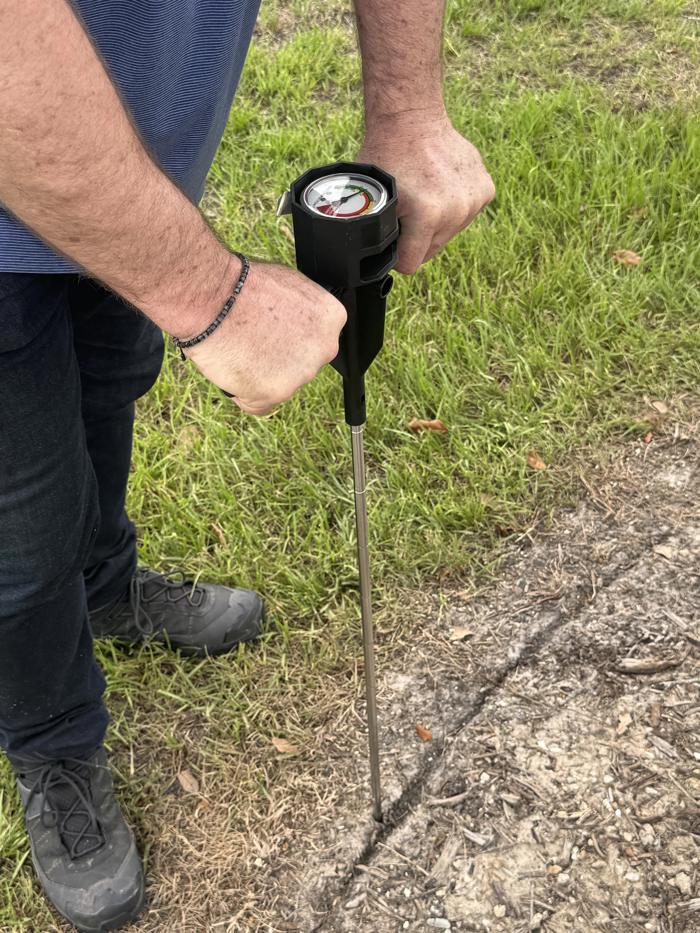
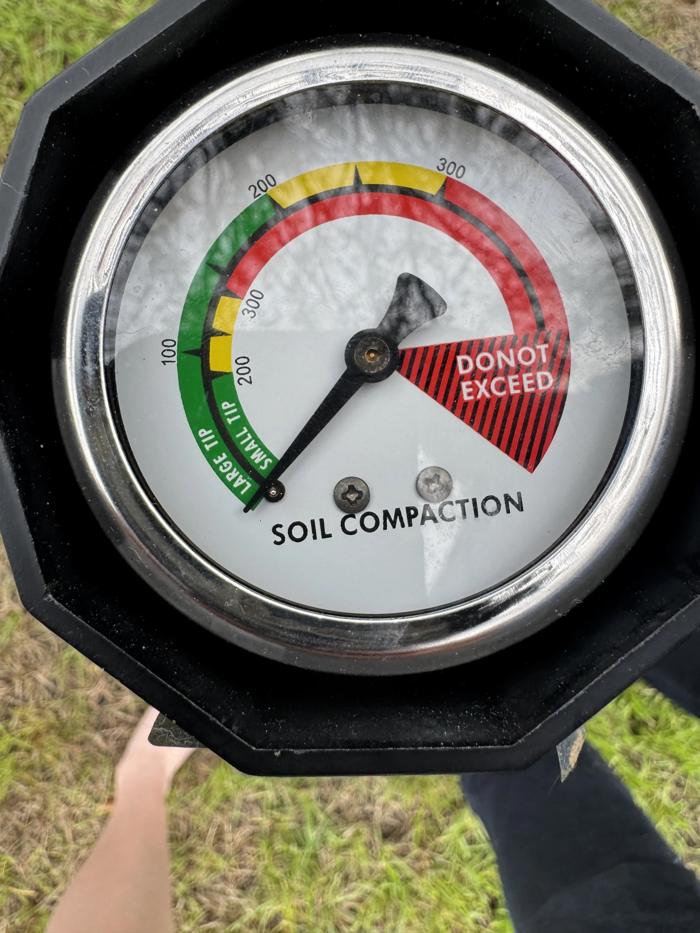
We push a probe into the ground and write down where it stops.
A dial cone penetrometer reads the pressure it takes to push into the soil. We record the depth where it reaches 300 psi, in moist soil, at two rings around each tree (the root ball edge and the drip line) and in four directions. Absorbing roots live in the top 12 to 18 in (30 to 46 cm). If the probe stops at 4 in, that is all the room they have.
The roots are effectively planted in a pot.
Shallow roots that dry out fast.
Room for most of the absorbing roots.
The roots can go where they need to.
Our readings around stressed oaks at one large special district, October 2026. 46 of 56 readings hit 300 psi within 6 in (15 cm). Six were restrictive, three workable, one good. The honest part: hardness alone did not separate a healthy oak from a stressed one. The next round adds readings in open turf as a control. This is our field scale, not a published standard.
Community age
How old the community is changes what the ground needs.
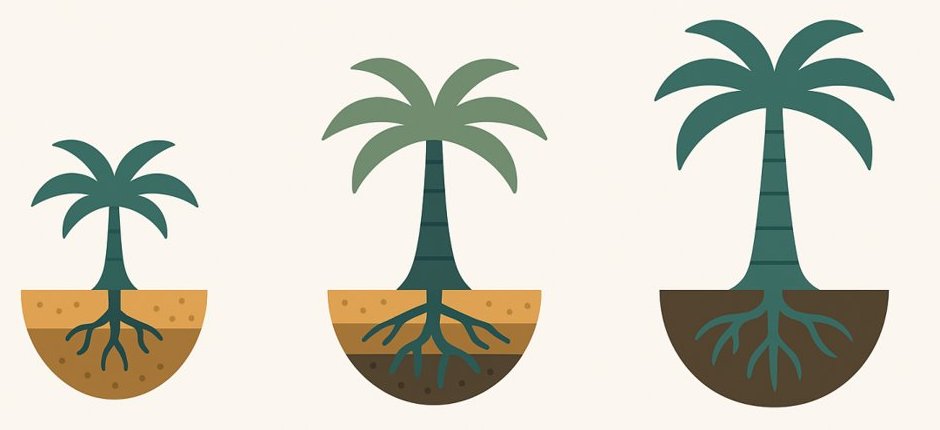
The soil improves with time, slowly. We place every community in one of three phases. The phase guides the arborist’s call and the budget. It does not set the tier: every palm still enters at Monitor.
Adaption
New palms in poor, compacted soil, often in less than ideal spots. Soil and irrigation are still settling, and disease can arrive unseen.
Highest risk, biggest payoff. Frequent deep watering, organic matter, mulch kept off the trunk.
Strengthening
Better water retention, less compaction. The right time to assess palms under a health program, replace the strugglers, and move to monitoring and fine-tuning.
Highest long-term return. Ease irrigation back to push roots deeper. Complete slow-release feeding, more often rather than heavier.
Maturity
The soil is healthier and works. The focus moves to consistency, planned replacements, and aging palms outgrowing their space.
Steady care. Little supplemental water outside a real drought. Annual organic matter. 9-and-3 pruning, because over-pruning strips the palm’s potassium and magnesium reserves.
Chapter takeawayIf the probe stops at 4 in, that is all the room they have.