Skip to content
ComingThe Ptolemy client portal: your map, reports, schedule and spending in one place.Portal coming:See what’s insideClient sign-in
Ptolemy(239) 467-0142Request the free master planFree master plan
Soil and irrigationChapter 5 of 7
5

Establishment

Water is the lever.

This is the large-oak establishment program we run for a special district in Southwest Florida, laid out step by step. The same thinking, scaled down, guides every new palm and tree we look after.

Step 1 · The challenge

A moved oak keeps its canopy and loses about 90% of its roots.
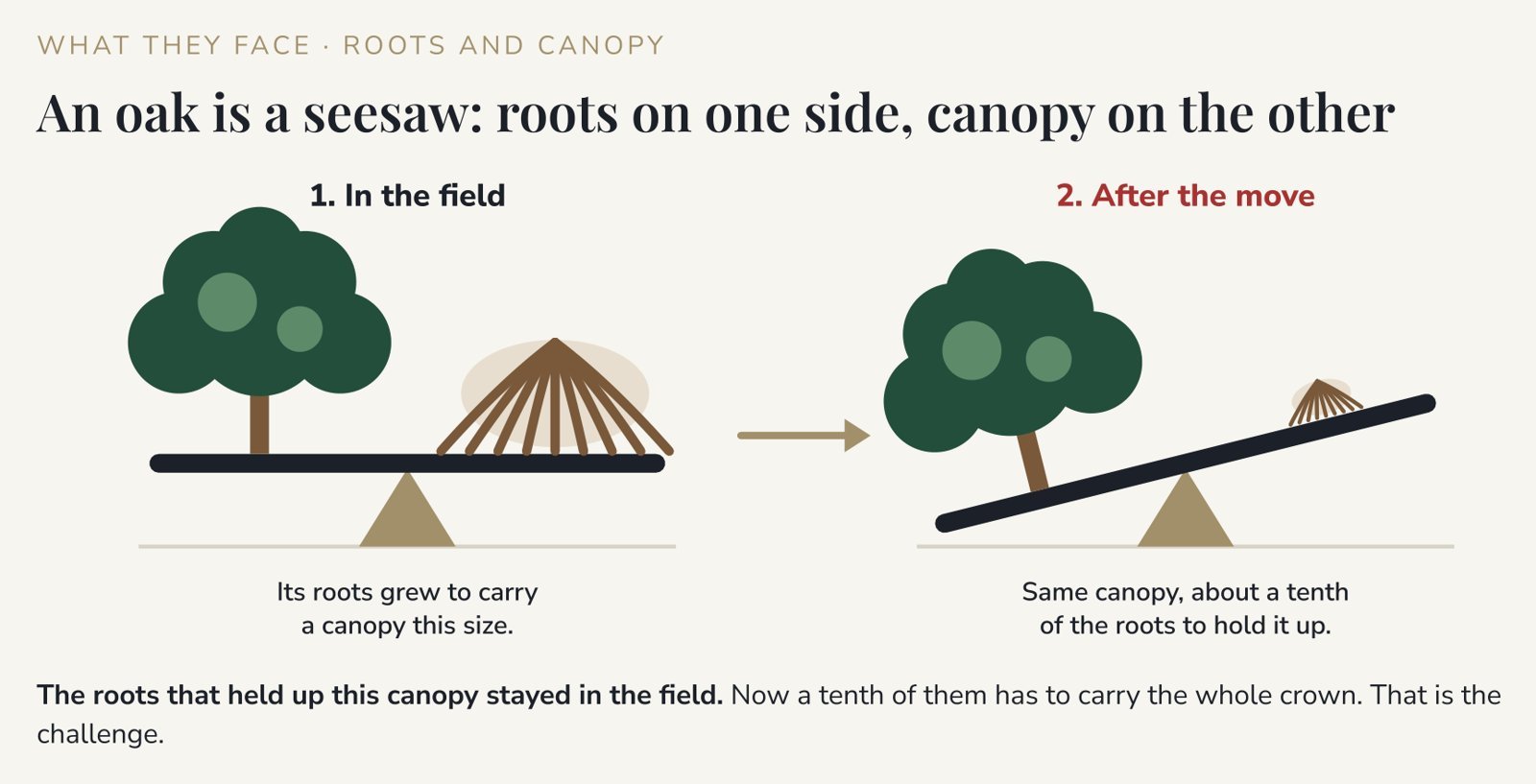
An oak drawn as a seesaw: in the field, full roots balance the canopy; after the move, the same canopy sits on about a tenth of the roots
The seesaw. About 90% of the root system stays in the ground when a large oak is dug and boxed (Dagit and Downer, USDA Forest Service).
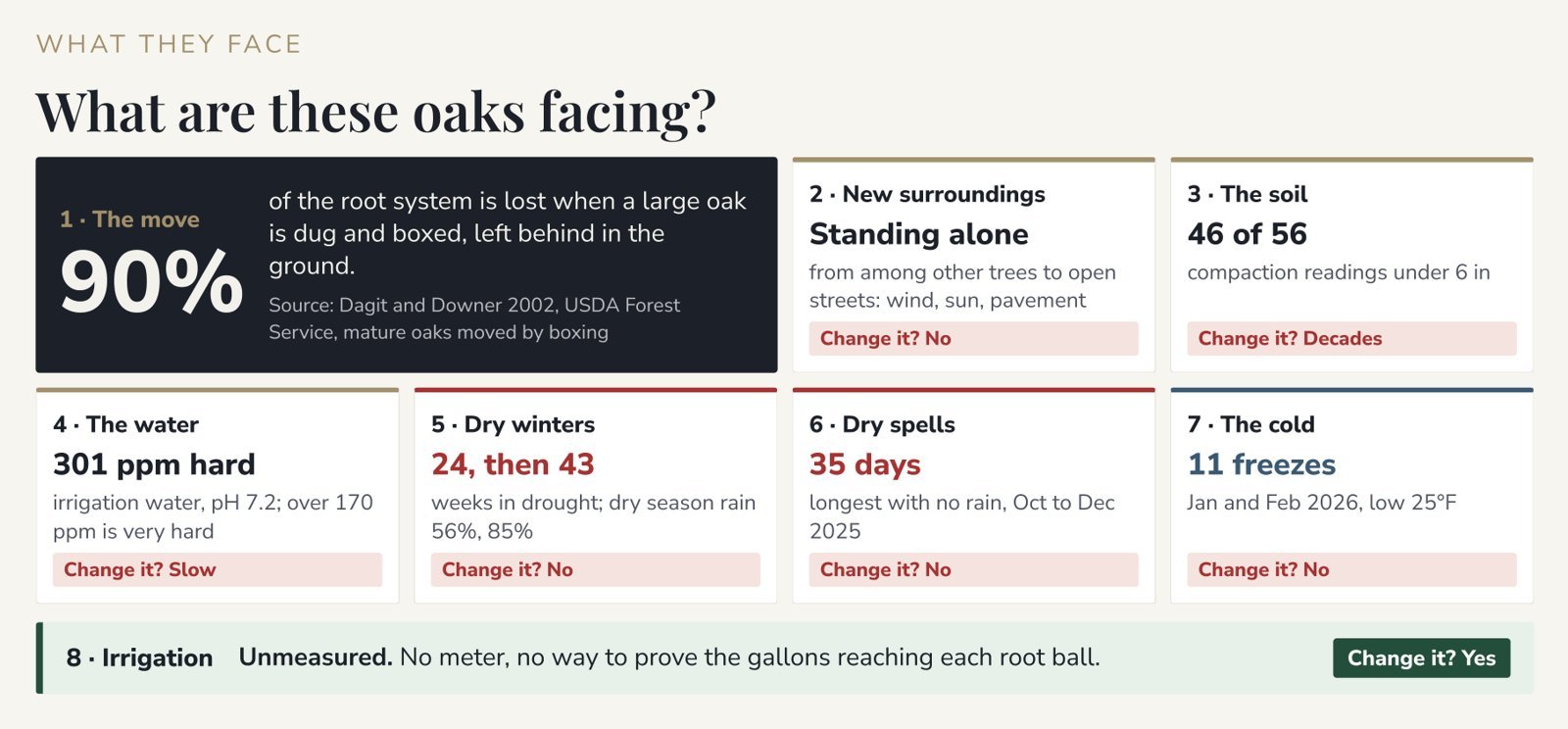
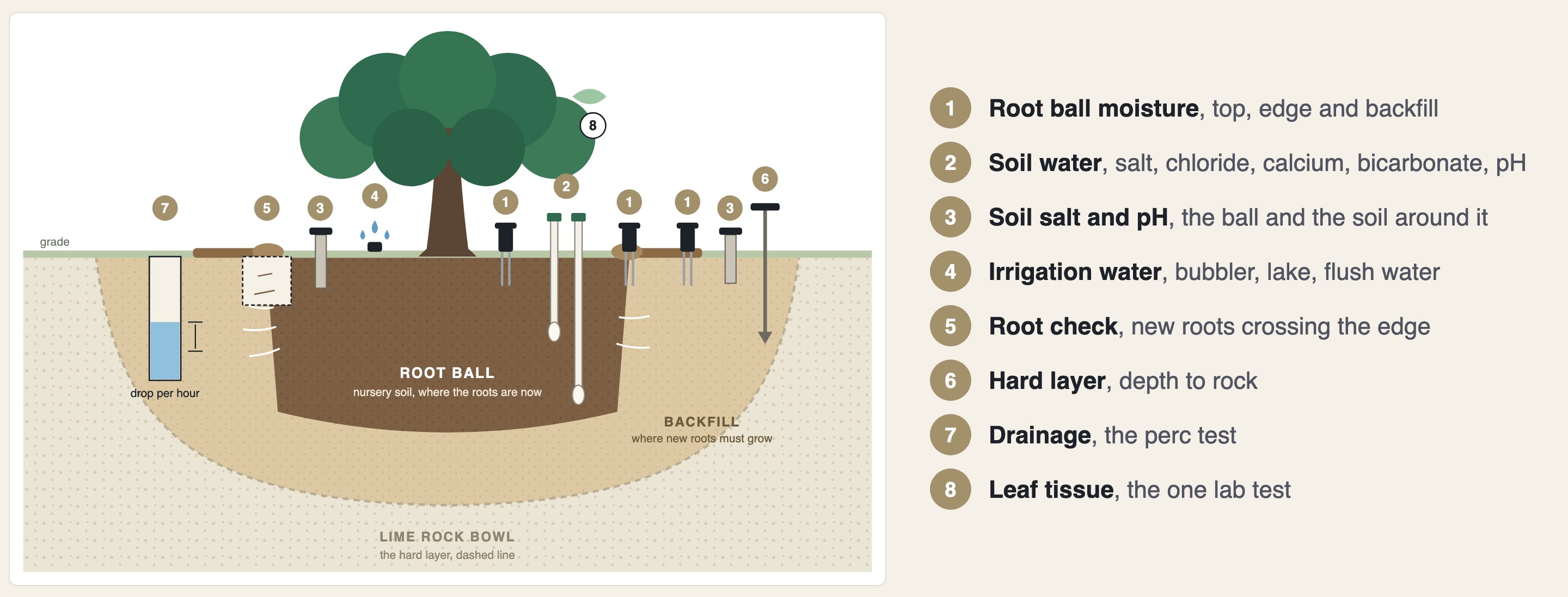
Eight things working against moved oaks and whether each can change: the move, new surroundings, the soil, the water, dry winters, dry spells and cold cannot be changed quickly; unmeasured irrigation can
Eight things working against a moved oak. Seven of them we cannot change, or not quickly. Irrigation is the one we can.

Step 2 · How long and how much

About 3 to 4 months per inch of trunk.
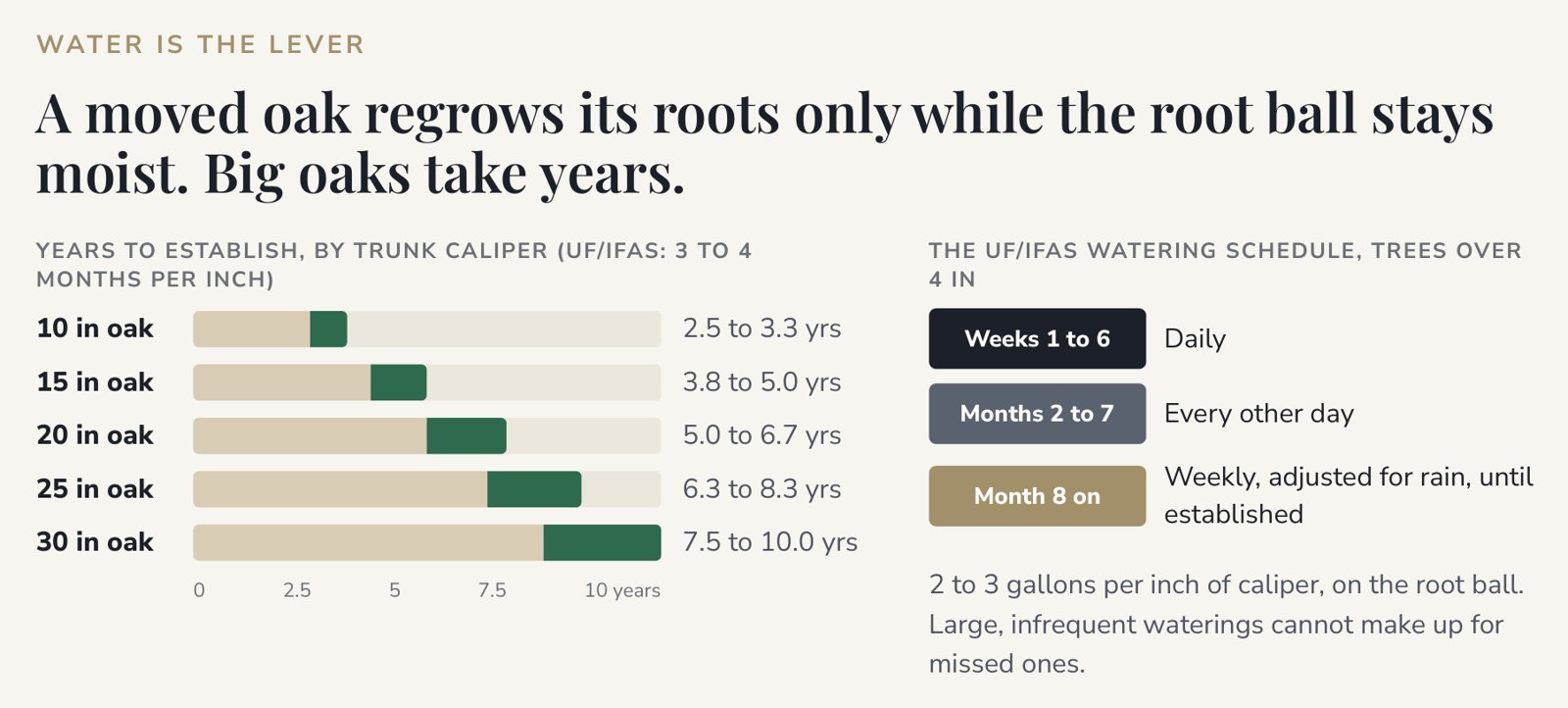
Years to establish by trunk size: 10 inch oak 2.5 to 3.3 years up to 30 inch oak 7.5 to 10 years; UF/IFAS watering schedule daily for weeks 1 to 6, every other day months 2 to 7, then weekly
A 20 in oak takes 5 to 7 years. 2 to 3 gallons per inch of trunk, on the root ball. Large, infrequent waterings cannot make up for missed ones.
Trees

About 3 to 4 months per inch of trunk caliper, confirmed in the field. Daily for 6 to 8 weeks (the full 8 for dry-season plantings, November to May), 3 days a week through year one, then weekly until established. Never down to rain alone in the dry season.

Container palms

6 to 8 months. Uniformly moist, never saturated, with the original ball checked on its own. Potting soil dries faster than the ground around it.

Large field-grown palms

12 months or more. Water the soil, never the crown. No gallon chart: the arborist sets the volume from ball size, soil and drainage.

Visits

Weekly for the first 3 months on dry-season plantings. Every 2 weeks in the rainy season, plus a check within 2 days of a 3 in (76 mm) rain or a tropical storm.

Step 3 · Feed with water, never without

Too much, without water, grows a canopy the roots cannot carry.
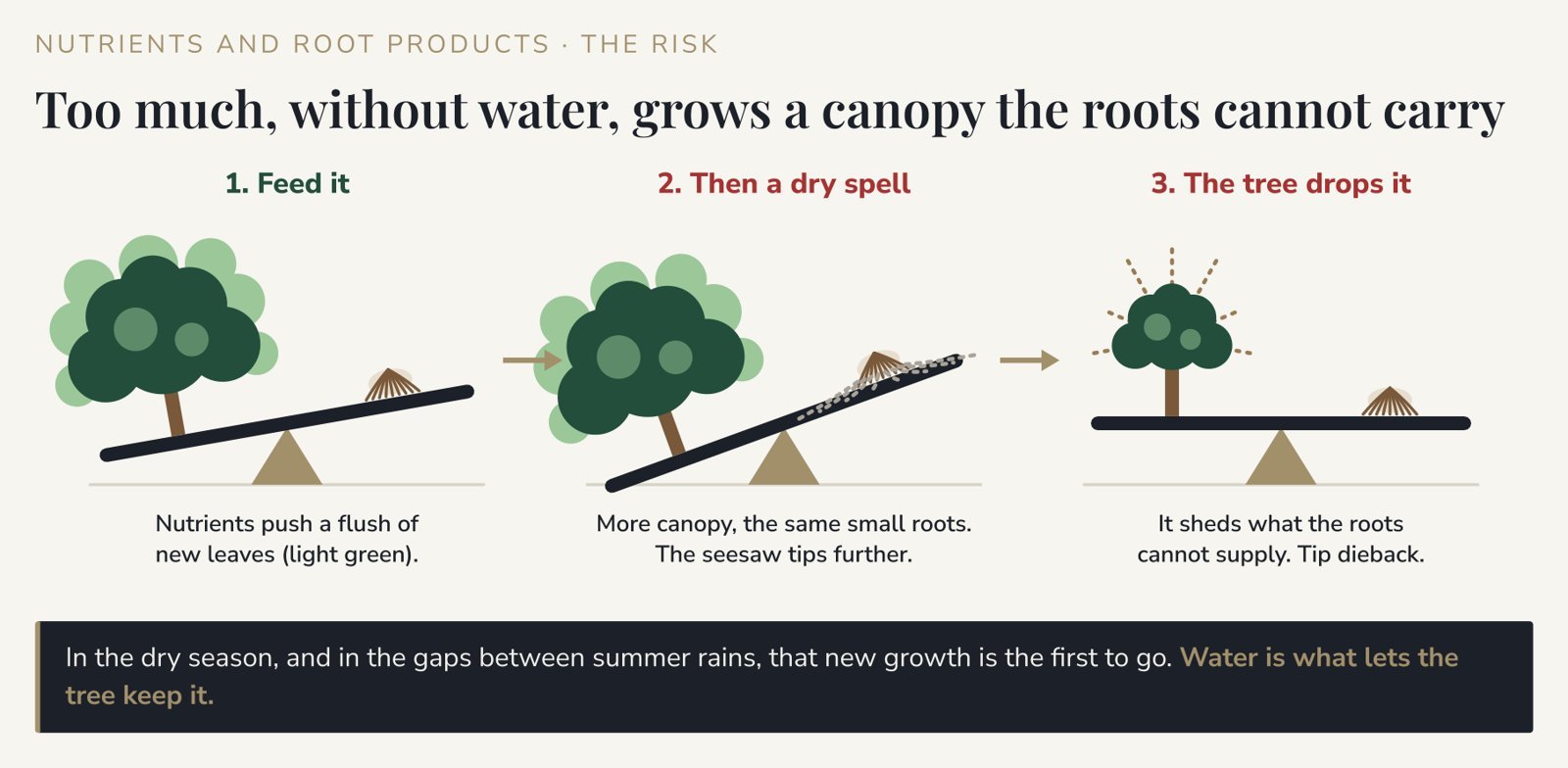
Three steps: feeding pushes a flush of new leaves, a dry spell tips the seesaw further, the tree drops what the roots cannot supply as tip dieback
Feed a new tree and it pushes new leaves. A dry spell comes, and the tree sheds what its small roots cannot supply. That is tip dieback. So water comes first: our new trees get fertilizer and MitoGrow on 2 visits a year, on a root ball we have checked, at rates a certified arborist signs, and never June 1 to September 30, per county ordinance.

Step 4 · When the rain stops

In the dry season, we put the rain back.

On the large oaks, a measured flush of clean hydrant water rinses salt out of the root ball. Only when the soil water test shows salt has built up, and only if the ball drains.
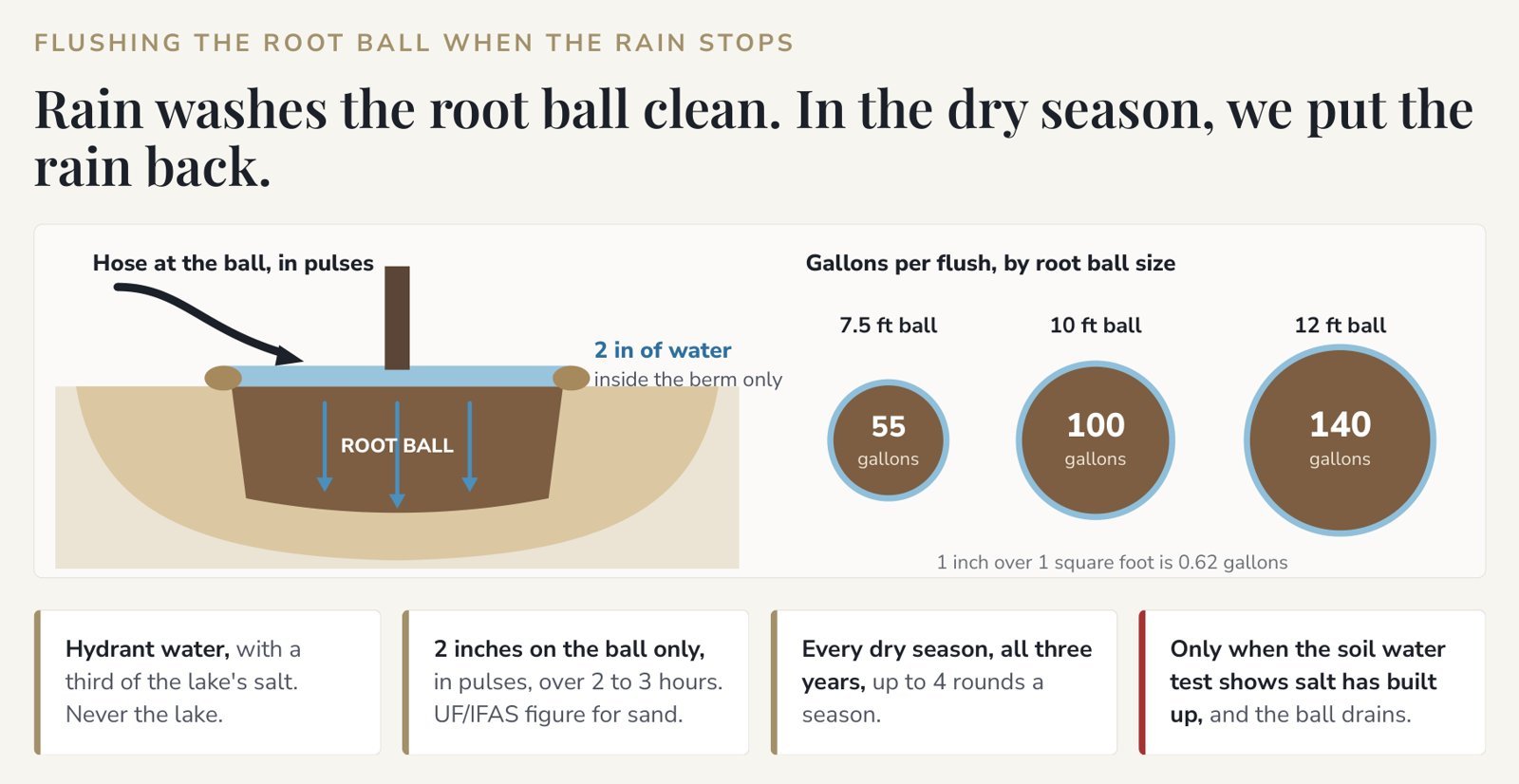
Flushing the root ball with 2 inches of water inside the berm: 55 gallons for a 7.5 foot ball, 100 for 10 feet, 140 for 12 feet
The flush. 2 in of water on the ball only, in pulses over 2 to 3 hours. The gallons are base estimates; the arborist sets the amount tree by tree.
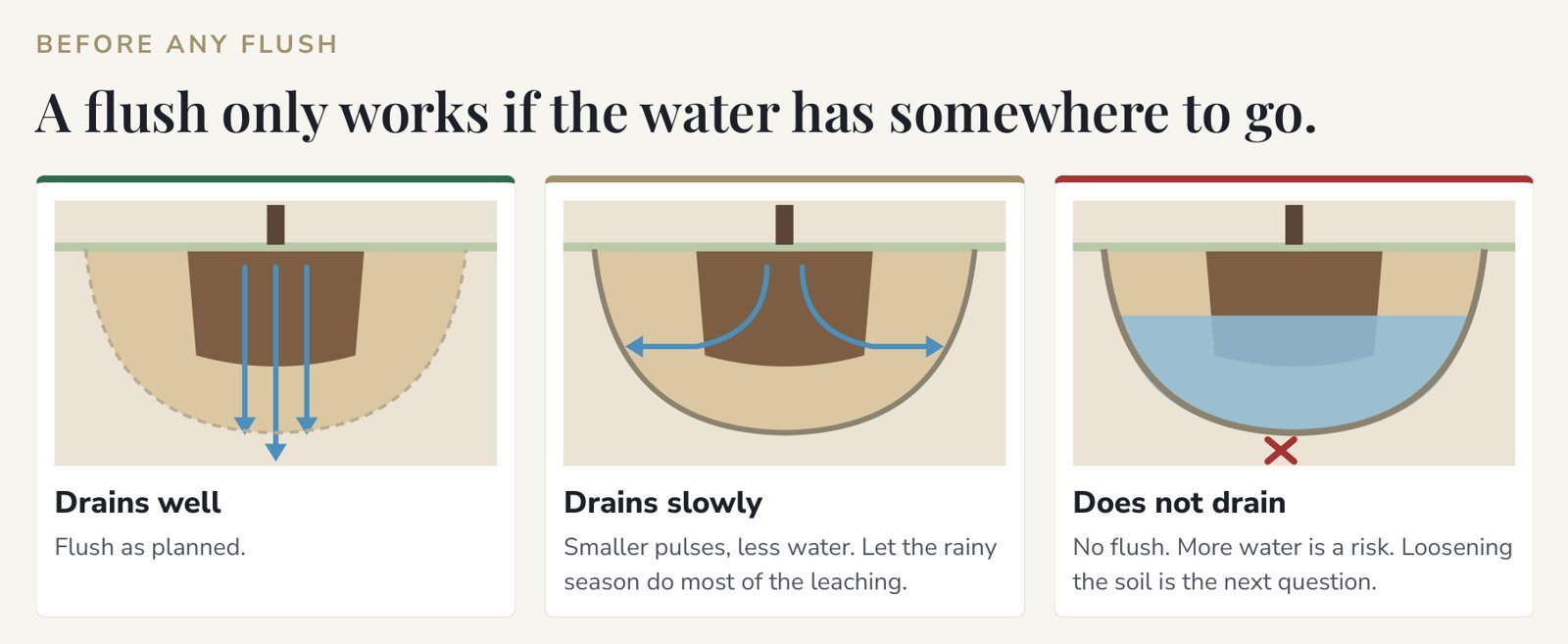
Three drainage cases: drains well, flush as planned; drains slowly, smaller pulses; does not drain, no flush
Drainage first. A flush only works if the water has somewhere to go.
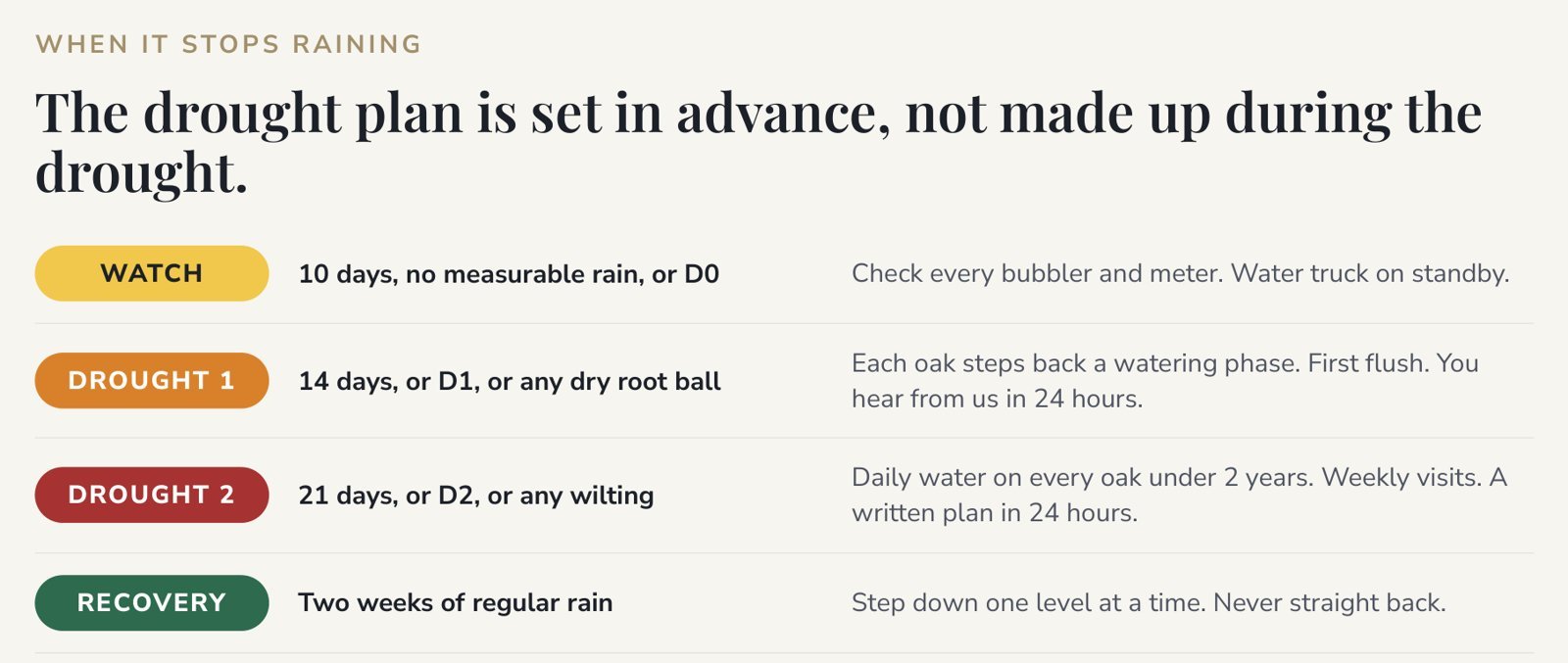
Drought plan: Watch at 10 dry days, Drought 1 at 14 days or any dry root ball, Drought 2 at 21 days or any wilting, Recovery after two weeks of regular rain
The drought plan is set before the drought. Triggers by dry days and the U.S. Drought Monitor level. In a drought: no fertilizer, no root inoculant, no pruning of new dieback, no decompaction. Water comes first.

Step 5 · Stepping down

Front-loaded when the tree is most at risk.

Year 1About 25 visits

Setup, then every week for 8 weeks, every 2 weeks to month 6, then every 2 weeks in the dry season and monthly in the wet.

Year 212 visits

Monthly. Fertilizer and MitoGrow on 2 visits a year, both years. The flush and rescue on top, as the readings call for them.

After 2 yearsRegular monitoring

The tree joins the Health Program visits with every other palm and tree.
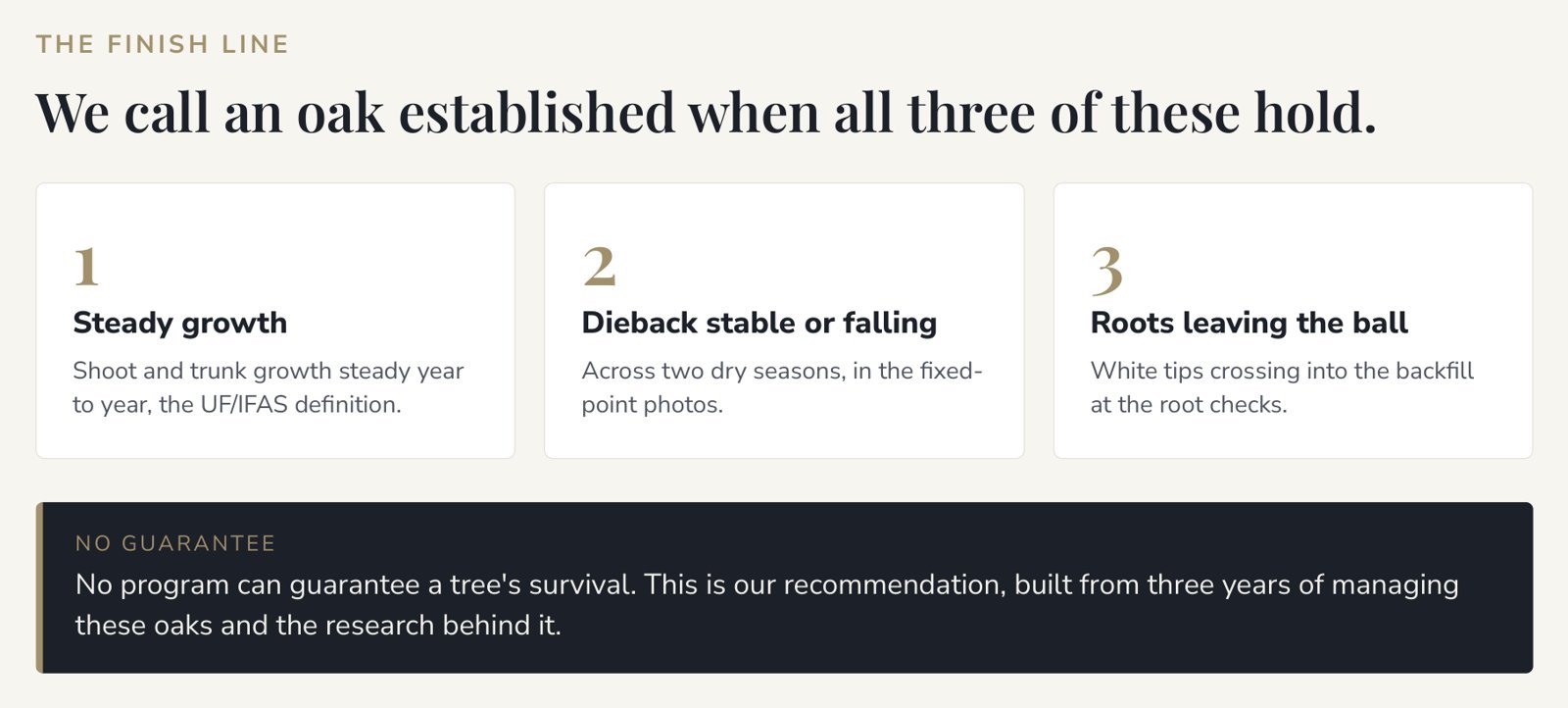
Established when all three hold: steady growth, dieback stable or falling across two dry seasons, roots leaving the ball. No program can guarantee a tree's survival.
The finish line. Steady shoot and trunk growth, dieback holding or falling across two dry seasons in fixed-point photos, and roots crossing out of the ball. Then the arborist sets a normal care cadence.

What it has done so far

One special district, three years in.

Root collar work, irrigation fixes and measured water, through two hurricanes and a drought. We do not credit any one treatment, and we cannot promise any one tree.

1,094to 1441,094 trees with tip dieback in April 2024 (oaks, hollies, magnolias and maples). 144 oaks in October 2026, counted tree by tree, while the oak count doubled.
88%Of all oaks now grade Normal, up from 69%.
80%Canopy health or better is Normal. It is the target we manage to, not a guarantee.

Same spot, same tree, about two years apart

Establishment, photographed from fixed points.
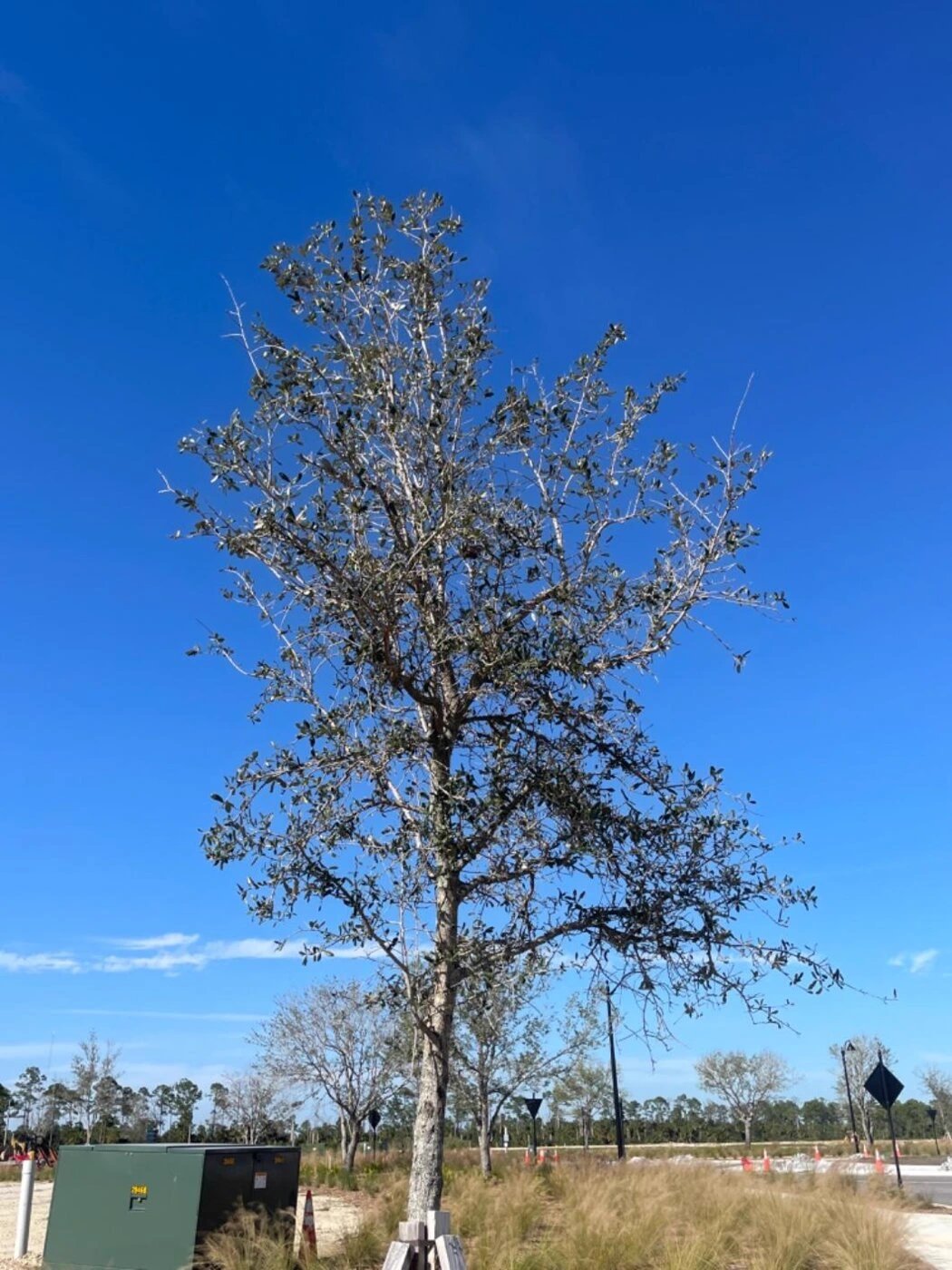
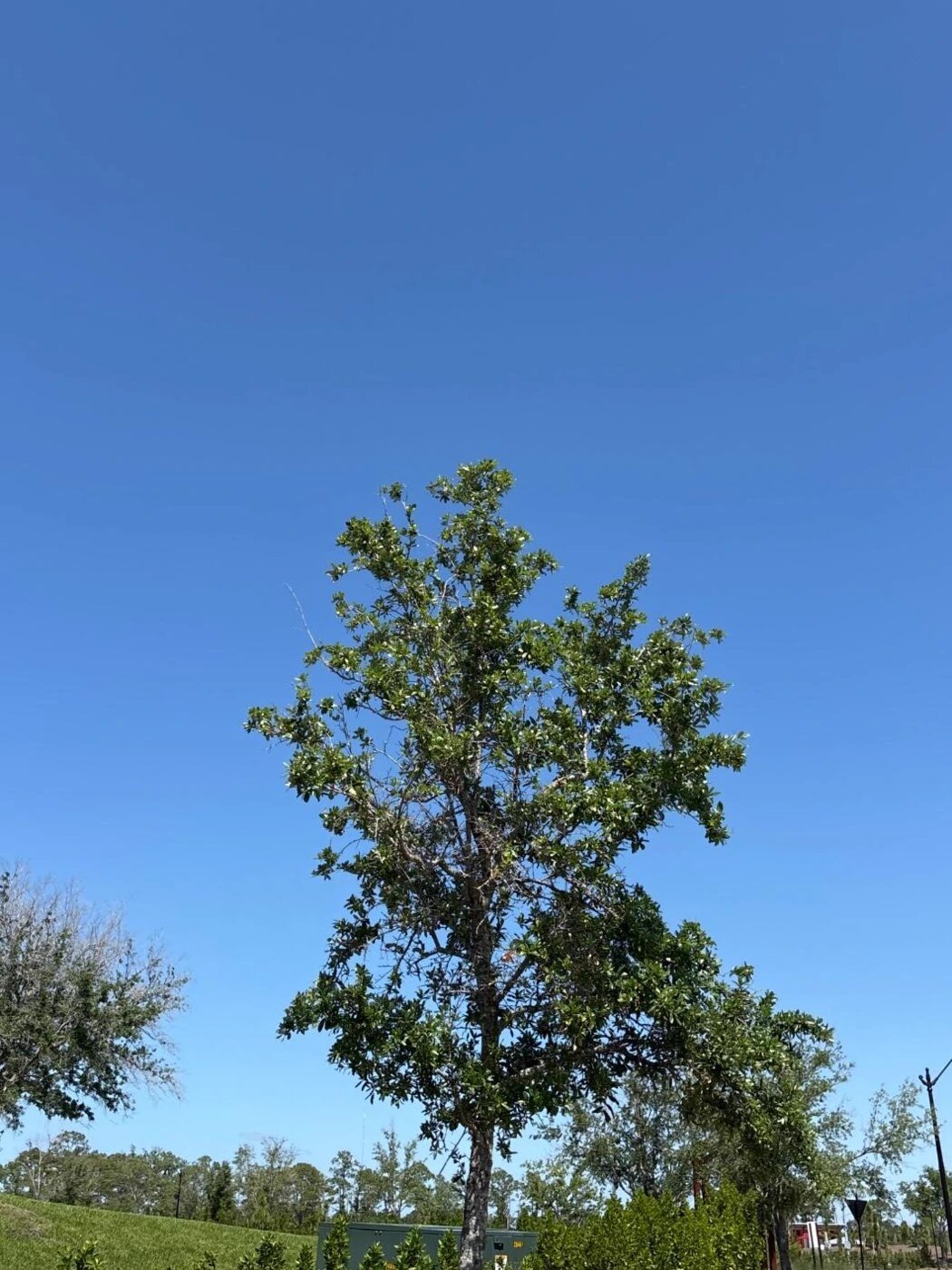
A newly planted oak with a thin canopy, December 2023Dec 2023
The same oak with a fuller canopy, April 2025Apr 2025

Live oakA thin first-year canopy, then filling in under an establishment program.
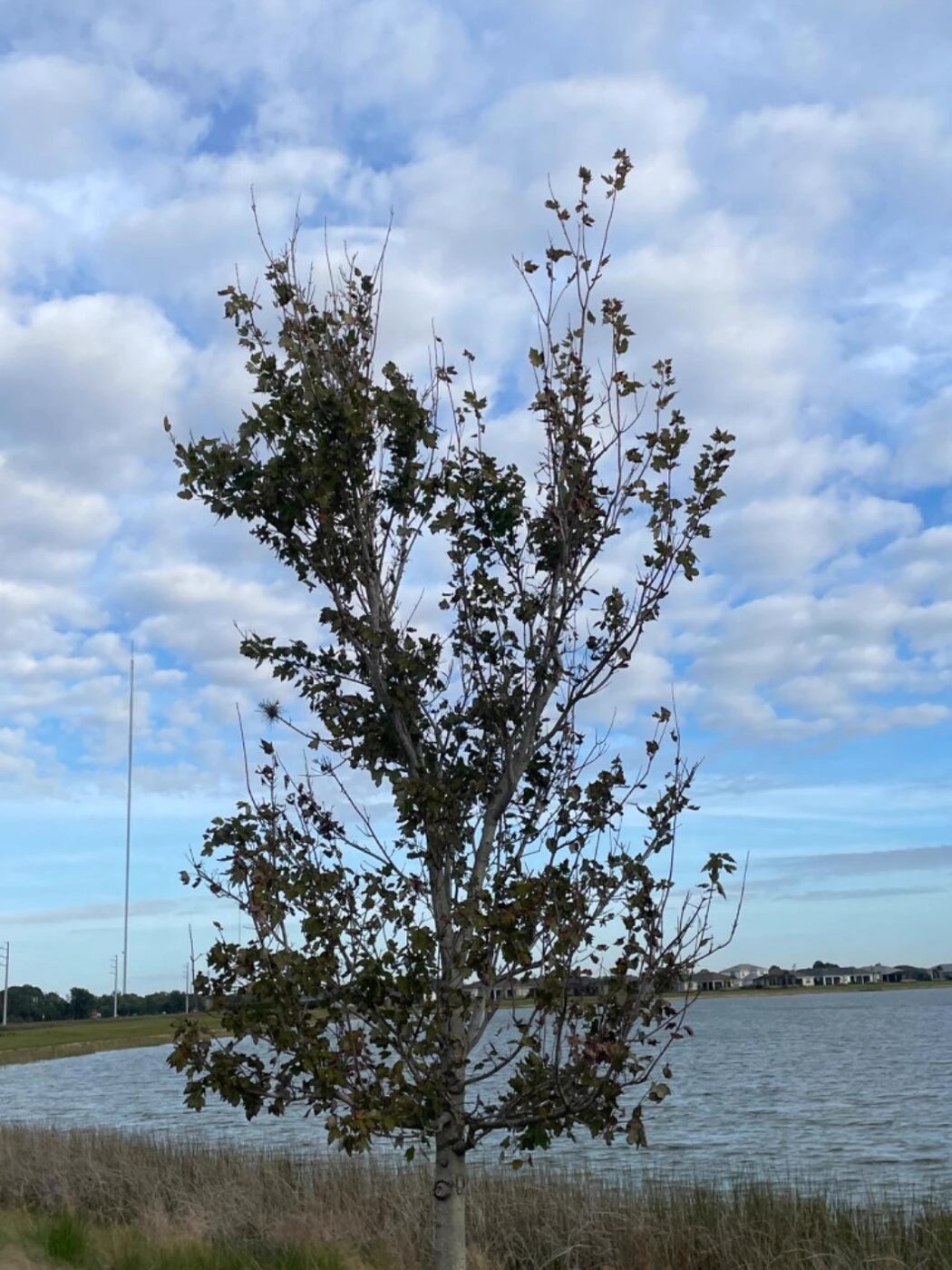
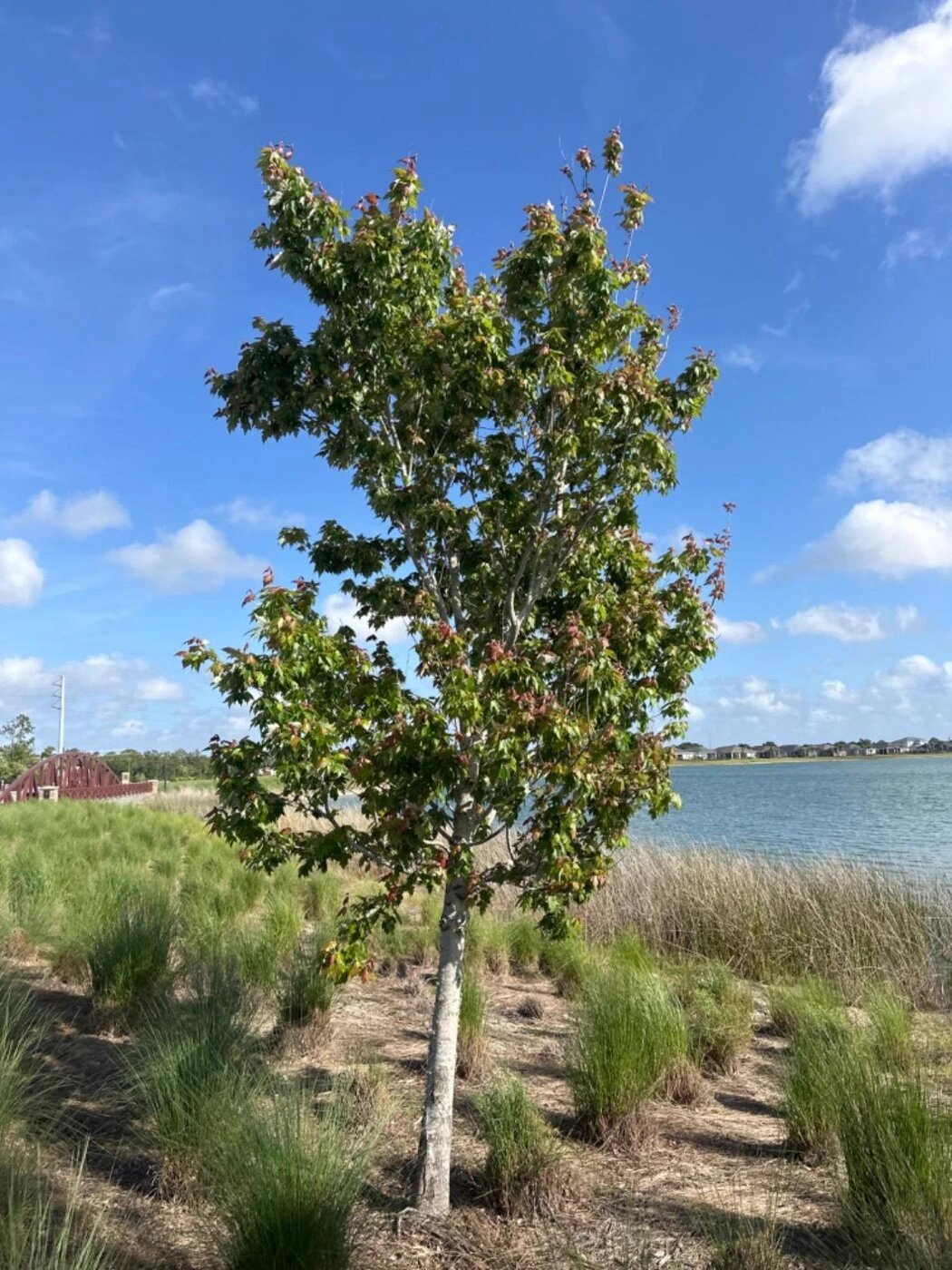
A young red maple at a lake edge, December 2023Dec 2023
The same maple leafed out, April 2025Apr 2025

Red mapleA lakefront planting, leafed out and growing in its second spring.

How we care for a new planting

Rule out the move before the diagnosis.

Early decline on a new or moved plant is usually the move and the site: a buried flare, a mulch volcano, irrigation that missed the ball, compacted soil. We check those first.

An initial assessment

We do not install. We give every new palm and tree an initial assessment, graded to Florida Grades and Standards, and report the findings before or after you accept it from the installer. Acceptance is between you and your installer. How grading works

Mulch in the ring, not on the ball

4 to 6 in (10 to 15 cm) of coarse mulch in the watering ring, held off the trunk. Little or none on top of the ball, where it catches light irrigation before the roots do.

A berm that holds water

In sand, split the volume into rounds and build a berm so the water sits over the ball long enough to soak in.

Stakes come off

Anchors outside the ball. Palms get lumber blocks strapped to the trunk, never nails, cable or chain. Tree support comes off by the end of the first growing season.

No balancing cuts

Dead or broken wood only. We do not thin a new tree to match its smaller root system.

Untie the fronds

Tied fronds left on a new palm hold moisture in the bud. They come off at installation.

What we promiseWe promise how we do the work: to the spec, on the schedule we agreed, with the record to show it. We cannot promise that a living palm or tree survives. Water, soil, weather and the install all play a part. A healthy plant is its own best defense, which is why we get the water and the ground right first.

Chapter takeawaySeven of them we cannot change, or not quickly. Irrigation is the one we can.