
Why do palms starve with a landscaper on site?
This is not the landscaper's fault. Most crews are hired to maintain turf, shrubs, and beds, and palm health care is a separate discipline. The bigger issue is the product. Lawn fertilizer is heavy on nitrogen, and on a palm that extra nitrogen can push growth the palm cannot support and deepen the very deficiencies you are trying to fix. Palms need a complete palm-specific fertilizer.
Why Florida soil works against palms
Southwest Florida soils are sandy, fast-draining, and low in organic matter, so water-soluble nutrients leach below the root zone quickly, sometimes within a single heavy rain. On top of that, soils and irrigation water often run alkaline. High pH does not remove nutrients, it locks them up. Iron and manganese can be present and still be unavailable to the palm when pH climbs above roughly 7.5. Many communities irrigate with reclaimed water, which raises pH a little more with every cycle. So the fertilizer may be down, and the palm still cannot reach it.
The deficiencies to know
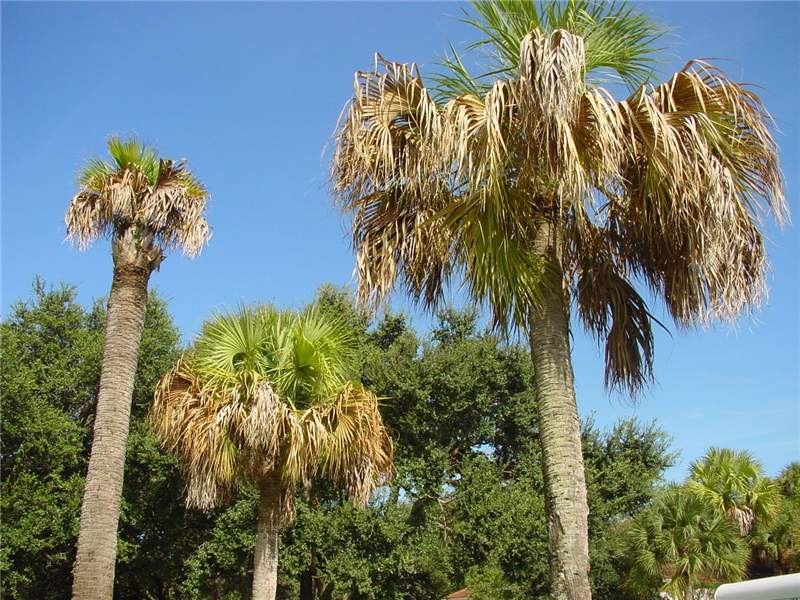
Where a symptom shows tells you what it is.
| Potassium (K) | The most common palm deficiency in Florida. Translucent yellow-orange spotting and frizzled tips on the oldest lower fronds. |
| Magnesium (Mg) | Broad yellow bands along older-frond edges with a green center. Never fatal on its own. |
| Manganese (Mn) | Frizzletop. New growth comes in weak, streaked, and curled. Locks up fast in alkaline soil. |
| Iron (Fe) | Pale new fronds, usually a pH or root problem rather than a true shortage. |
| Boron | One of the micronutrients a complete palm fertilizer carries. |
What a complete fertilizer is
A complete palm fertilizer carries the full set: nitrogen, potassium, magnesium, manganese, and micronutrients like iron and boron. N-P-K alone is not enough. The documented UF/IFAS standard for landscape palms is an 8-2-12 analysis with 4 percent magnesium plus micronutrients, in controlled-release form. An incomplete fertilizer can leave the deficiency that is actually driving symptoms uncorrected, and can throw ratios out of balance enough to trigger a second deficiency.
How often, and when
Frequency matters more than dumping a lot at once. In sandy soil, smaller, more frequent feedings hold a steadier supply within reach of the roots and lose less to leaching. Ptolemy's position is that the productive feeding window here runs roughly October through May. That runs against the instinct to feed in summer, but summer rain leaches nutrients away and many counties restrict nitrogen then. The well-timed feeding going into the dry season is the one that carries the palm through the cool months. The decline you see in February often started in November.
Why testing and timing beat guessing
A soil test shows what the soil holds and what the pH is doing, which on a reclaimed-water property is often the real story. The program manages what the roots can take up, as well as how much is applied. For routine single-palm diagnosis, Ptolemy reads symptoms by frond age and pattern rather than relying on one-off leaf-tissue tests, because tissue levels shift with season, recent feeding, and which frond is sampled, so a single reading can mislead. A fertilization program is health care for the palms, not cosmetics. Removing and replacing a mature palm costs far more than feeding it correctly for years.