Tree Risk Assessment: What TRAQ Means When We Call a Tree High Risk
A removal call should follow a method a board can read: how likely the tree is to fail, what it would hit, and how bad that would be.
 Jeff Kaulbars
Sooner or later every community has the conversation. A resident wants a big tree out. Another resident wants it saved. The board needs an answer it can stand behind, in front of both of them and, sometimes, an insurer or the county.
That is what tree risk assessment is for. Jeff Kaulbars holds the ISA Tree Risk Assessment Qualification, known as TRAQ. Here is what it means for a board.
What TRAQ is
TRAQ is a qualification from the International Society of Arboriculture for arborists who already hold a credential such as ISA Certified Arborist. It is two days of instruction followed by a written and field assessment, and it is renewed by retesting. It trains one method, the ISA Best Management Practices for Tree Risk Assessment, which ties to ANSI A300 Part 9, the national standard for tree risk assessment.
The point is consistency. Two qualified assessors looking at the same tree should reach a similar rating for the same reasons, and write them down.
The three questions
- Likelihood of failure: how likely is the tree, or the part being assessed, to fail within a set time frame, given its defects, species, load and site? Rated improbable, possible, probable or imminent.
- Likelihood of impact: if it fails, how likely is it to hit something? That depends on the target and how often it is there.
- Consequences: if it hits, how bad is it?
Failure and impact are combined, then matched against consequences. The result is a risk rating: Low, Moderate, High or Extreme. The rating drives the recommendation, from monitor, to prune or reduce, to remove.
Targets change everything
A cracked limb over an empty corner of a preserve is not the same risk as the same crack over a clubhouse entrance. Targets are the people and property within reach of a failure. Occupancy is how much of the time they are there. A building, a row of parked cars or a busy walkway is a constant target. A rarely used corner is not. In Southwest Florida, the load we plan for is hurricane and tropical storm wind.
Three levels of looking
- Level 1, a limited visual: a walk-by or drive-by of many trees, looking for obvious problems.
- Level 2, a basic assessment: a full 360-degree ground inspection of one tree. This is the standard level.
- Level 3, advanced: decay tools, aerial inspection or root investigation, when a Level 2 finding calls for it.
Risk is not the same as health
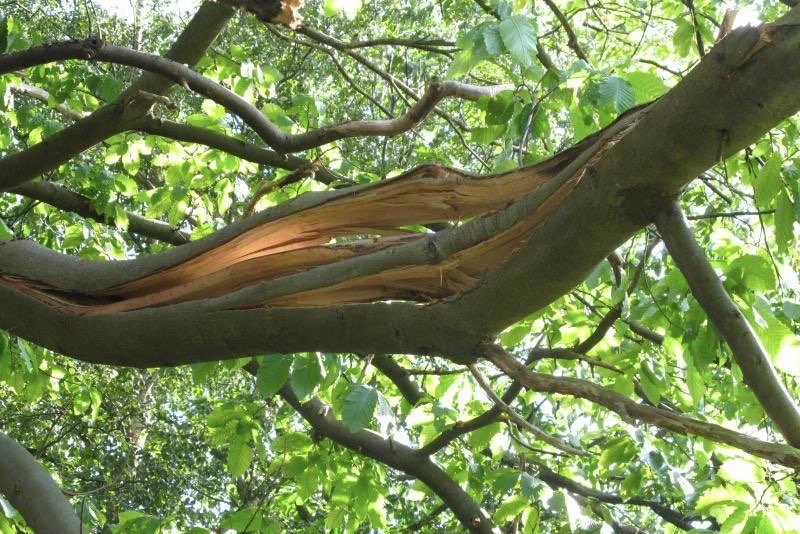
A tree can look perfectly healthy and still carry high structural risk. Two trunks pressed together at a fork with bark trapped between them (included bark) is a common example. It can split in a storm while the canopy is still green and full.
So our reports keep risk separate from condition. Options for a defect like that run from cabling or bracing a valuable tree, to removing the weaker stem, to removing the tree. That is our certified arborist's call.
What the record holds
For each assessed tree we document the species, size and mapped ID, the targets and their occupancy, each defect with photos, the likelihood and consequence judgments, the rating, the recommended mitigation, and the assessment date and time frame.
No tree or palm is removed without a written determination from an ISA Certified Arborist naming the inventory ID, the reason and the date. When a tree is an immediate hazard, it is made safe first, and the determination follows within 2 business days.
Where a county requires a removal permit, the property owner or association pulls it, and our TRAQ assessment is what supports the application.
What it does not do
A risk rating is a professional judgment for a time frame. It is not a promise about what a storm will do. Trees are living things, and we say so. What the method gives a board is a decision made the same way every time, on paper, with the reasons attached.
What to do
If a tree on your property has residents arguing, ask us for a tree risk assessment. You get a rating, the reasons for it, and a recommendation the board can read aloud at the next meeting. To put every tree on the same footing, ask for the free master plan.