Why Palm Fertilizer Has a Floor: Steady Beats Heavy
A palm keeps almost nothing in reserve, so the number of feedings a year matters more than the size of any one of them.
 Jeff Kaulbars
When budgets get tight, the first thing many properties cut is the number of palm feedings. Four a year becomes two. Two becomes one big one. On paper it saves money. On palms, it usually costs more later.
Palms have no savings account
Trees store energy. An oak keeps 15 to 30 percent of its dry weight as stored starch, in the trunk, roots and branches, and can ride out a lean year. A palm stores less than 10 percent, mostly in the trunk. It depends on a steady supply of water and nutrients, week to week.
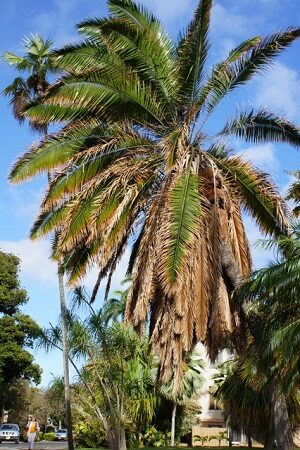
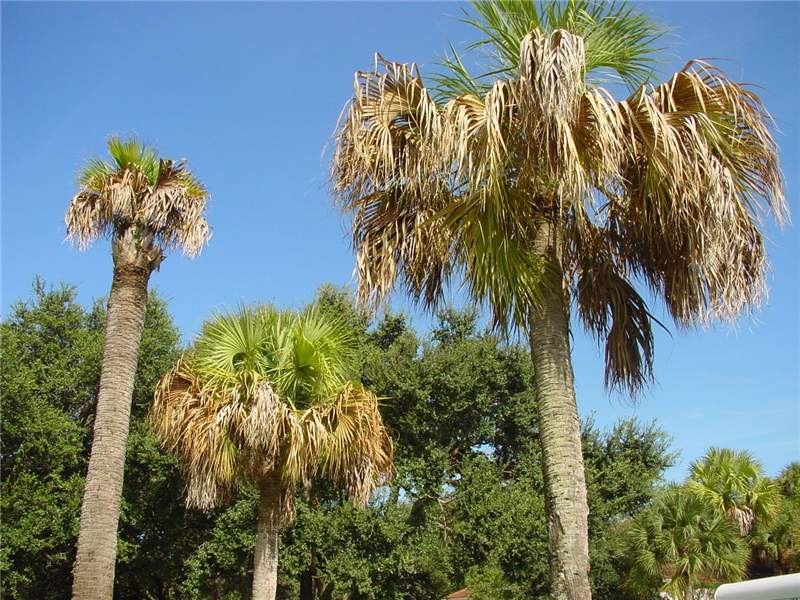
That is why magnesium, potassium and manganese shortages show faster on palms than on trees. By the time a symptom shows, the window to prevent it has often closed.
Sand does not hold a big dose
Our soils are mostly sand. Water-soluble nutrients leach quickly, sometimes in a single heavy rain. One large application in a wet month can be gone before the palm gets much of it. Slow-release fertilizer on a regular schedule keeps something available in the root zone through the year.
Feeding also only works when the nutrients can move and the soil lets them go. Rain opens that window. Drought and cool weather close it. A steady schedule puts product in the ground for every window that opens.
Our floors
- A complete fertilizer only: nitrogen, phosphorus, potassium, magnesium and micronutrients. The university standard is a slow-release 8-2-12 analysis with 4 percent magnesium.
- At least 4 applications a year on large communities.
- At least 6 a year on residential properties, with monthly as the ideal.
- More often on properties in their first 10 years and on sites where uptake is limited by soil or water.
Local fertilizer ordinances come first. Many counties and cities restrict nitrogen in the summer rainy season, commonly June through September, and many restrict phosphorus. We check the ordinance before scheduling.
Lawn food is not palm food
Many properties assume the landscape contract feeds the palms. Usually it covers ground-level fertilizing with turf or shrub product. Turf fertilizer is heavy on nitrogen, and around palms it can push growth the palm cannot support with the potassium it has, which brings on potassium deficiency. A floor only counts if it is a complete palm fertilizer.
More is not the answer
A floor is about frequency, not volume. When palms decline for reasons that are not nutrition, more fertilizer does not help, and it can hurt. On one district, an outside company proposed heavier feeding for struggling oaks. The district's own landscape director answered:
“Applying additional fertilizer is not the solution to the concerns being observed.”
The real problem there was water during establishment. Feed a tree without water and the nutrients push new leaves the roots cannot support. When a palm on a full program is not responding, we check the soil pH and the irrigation water before adding product. The problem may not be the dose. It may be access.
How long it takes
Results on a deficient palm may be noticeable in about 3 months. Correcting an extreme deficiency can take 3 years, because the palm recovers by growing new, clean fronds, one at a time. We judge a program on whole-property health over 12 to 24 months, not on one palm in one season.
Feeding also does not make a palm immune to disease. A well-fed palm is better able to defend itself, and that is all we claim for it.
What to do
Check how often your palms are actually fed, and with what. If the answer is "with the lawn," or "once a year," ask us for the free master plan. On the Standard tier, every enrolled palm gets real palm nutrition on a schedule, with an inspection and photo record at every visit.